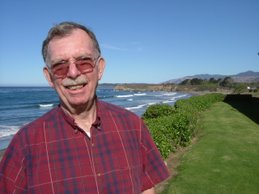
Below is Bishop John S. Spong's mediation today on the revolution in theology that the work of Charles Darwin has wrought. It outlines the task ahead if Christianity is to enter the 21st century with anything like intellectual rigor.
The Study of Life, Part 6
Rethinking Basic Christian Concepts in the Light of Charles Darwin
As I retraced Charles Darwin's steps through the Galapagos Islands, I contemplated anew his impact on traditional Christian thinking. I had been working intensively on Darwin for about three years in preparation for my book on eternal life. Darwin, more than anyone else, had shaken the foundations of belief in eternal life by defining human beings as animals with more highly developed brains, removing any sense of immortality from them. By the time we arrived in the Galapagos the time for any rewrites on this book was over. My manuscript was at my publisher, HarperCollins. The next time I will see this book will be in its published form. This book had been for me a grueling task since it drove me almost against my will to come to a new understanding of my faith. I discovered first that I could no longer make a case for life after death until I had journeyed to a place that was, as my subtitle suggests, "beyond religion, beyond theism and beyond heaven and hell." That was a direct result of my deep engagement with Darwin's thought. It is fair to say, however, that in the writing of this book I also became aware that Darwin's thought had also helped me to arrive at a new vision of what I believe will be the future of Christianity. Through this column I seek to share that process with my readers.
My struggle began with the recognition that the primary titles that we Christians have given to Jesus all carry with them a particular definition of what it means to be human. To call Jesus "savior" implies that human life needs to be saved from something. The same is true about the titles "rescuer," "redeemer" and "reconciler." This negative definition of humanity is why the traditional telling of the Jesus story focuses on Jesus' suffering, which was the price that Jesus had to pay for our salvation. The traditional Protestant mantra, "Jesus died for my sins," and the Catholic definition of the Eucharist as "the sacrifice of the Mass," both reinforce the assumption of human depravity that is a major theme filling Christian theology and history.
These distorting images began in a mythology that assumed that human life was a special creation, made in the image of God, and suggesting that human life originally shared in the perfection of God's finished creation. Falling from that status into what came to be called "original sin," however, quickly became the major focus of Christian theology. Starting with Paul, it has been the "fall" and its resulting distortion of God's creation that has been the bedrock of the way we have told the Jesus story. It was our sinful status that mandated God's divine rescue operation "for us and for our salvation." The heart of Christian theology, including such core doctrines as the Incarnation, the divinity of Christ, the Atonement and even the concept of God as a Holy Trinity, were all attempts to spell out the Jesus story in terms of this definition of what it means to be sinful. Human beings were those creatures who in an act of disobedience had destroyed the beauty of God's original creation and had plunged the whole world into sin. Charles Darwin's understanding of human origins ran directly counter to these assumptions. If Darwin was correct then this whole theological system, which featured the account of Jesus' sacrificial death to save us from our sins, was doomed to become inoperative.
If human life, as Darwin suggested and as modern science keeps verifying, is the product of millions of years of evolutionary history, then none of these theological formulas remain valid. Without an original, perfect and complete creation, there could never have been a fall from perfection, not even metaphorically. Original sin has thus got to go. Without that fall from perfection there was no need for God's rescue and no reason for Jesus to come to our aid. The idea of God as the punishing parent organizes religious life on the basis of the childlike and primitive motifs of reward and punishment. The cross understood as the place where Jesus paid our debt to this vengeful God becomes not just nonsensical, but it also serves to twist human life with guilt in order to make this system of thought believable. That is why Christian worship seems to require the constant denigration of human life. Christian liturgies constantly beg God "to have mercy." Our hymns sing of God's amazing grace, but the only reason God's grace is amazing is that it "saved a wretch like me." This theology assumes that God is an external being, living somewhere above the sky, whose chief occupations are two: first to keep the record books up to date on our behavior, thus serving as the basis on which we will be judged; and second to be ready to come to our aid in miraculous ways either to establish the divine order or in answer to our prayers. Darwin was only one part of the explosion of knowledge that rendered these ideas not only irrelevant, but unbelievable. Copernicus and Galileo had destroyed God's dwelling place above the sky by introducing us to the vastness of space, suddenly but not coincidentally rendering this God homeless. Then Isaac Newton discovered the mathematically precise and immutable laws by which the universe is governed, leaving little room in it for either miracle or magic, which rendered the miracle-working deity unemployed. One well-known English theologian, when he finally embraced these realities in the early 1980's, abandoned his Christian faith, pronouncing himself "a non-aggressive atheist." When asked why he was no longer a believer, he replied quite simply "because God no longer had any work to do."
It was Darwin, however, who applied the coup de grâce both to religion and to the belief in life after death, at least as traditional Christianity had proclaimed these things. To Darwin human beings were merely a work in progress. Far from being created perfect we had evolved into our present form like every other creature by "natural selection" over more than three billion years. Salvation built on the three premises of a perfect creation, a fall into sin and a rescue from above that was achieved on the cross became an exercise in fantasyland. Indeed the story of the sacrificial death of Jesus by crucifixion began to look bizarre. This theology made God appear to be a deity who required a blood offering and a human sacrifice in order to forgive. Jesus began to look like a perpetual victim, perhaps even a masochistic person who willingly endured, even welcomed, suffering and death on the cross. Human beings looked like guilt-ridden creatures whose sinfulness made the death of Jesus necessary. Finally, Christianity became a religion of guilt, which was encouraged liturgically. There was nothing about this scenario that could be called good news or "gospel," yet it persisted for centuries. These distortions in the Jesus message began to wobble under the impact of Galileo and Newton, but it was Darwin who made it clear that the Christian world could no longer go on pretending that nothing had changed. The foundations on which the Christian message had been erected had collapsed.
When I embraced what this meant existentially I came to the conclusion that if Christianity was to have a future, then I must find a new point of entry and a new way to hear and to believe the Jesus story. That was the challenge I had to meet before I could ever address the possibility of life after death. I began that reconstruction task in my book Jesus for the Non-Religious and now I had to complete this task by spelling out a new way to view eternal life.
I was delighted to discover that the greatest of the New Testament scholars in the 20th century, Rudolf Bultmann, regularly spoke of Jesus not as the "savior," but as the "revealer." That shift was not subtle. Bultmann was suggesting the Jesus "revealed" a new dimension of what it means to be human and in the process opened a new window into what it is to experience the presence of God. Suddenly I had found a whole new way to look at what divinity is in human life. Underneath the focus on sacrifice revealed in the gospels I began to view Jesus as one who was so deeply and fully human that whatever it is that we experience God to be could be seen in him and experienced through him. A new way to view the cross next began to come into view. The cross was not a sacrifice to placate an angry God, but a living portrait of a human life that was no longer controlled by the innate drive to survive. Here was a life free to give itself away, a life with no need to build itself up at another's expense. This was a new dimension of what it means to be human, what it means to live fully, to love wastefully and to be all that life was meant to be. When I got beneath the level of later explanation, which dominates the gospel narratives, and began to ask what was the Jesus experience that compelled his followers to stretch the words available to them to an infinite degree to enable those words to be big enough to capture their Jesus experience, I heard them saying we have met and encountered in the life of this Jesus everything that we mean by the word "God." It was that word "inflation" that gives us virgin births, wandering stars, miracles, parables, physical resuscitations and ascensions into heaven. They were trying to say that in his humanity, which seemed to break all human barriers, they had found a doorway into the meaning of transcendence, the reality of God. The way into divinity became for me the pathway of becoming fully human. It was to affirm that we are still evolving into we know not what. Jesus was a new dimension of life for which we may all be headed.
So I had to begin my quest for life after death by going into the depths of the mystery of life itself. Just as we now know that life evolved out of lifeless matter, that consciousness emerged out of life and finally that self-conscious life has emerged out of mere consciousness, so perhaps the day is now arriving when we will experience the possibility of entering a universal consciousness that is beginning to emerge out of self-consciousness. We are thus part of the oneness of life, bound together by a common DNA and that oneness makes us part of God. It also suggests that we are linked to eternity since God is found at the depth of the human.
These words can only scratch the surface of the thought I try to develop in my book on eternal life, but they do presage the path I walk. Charles Darwin, who for me made a new Christianity necessary, turns out to offer the clue to that new direction. This vision now stands before me. I invite you to join me in entering it.
Showing posts with label theology. Show all posts
Showing posts with label theology. Show all posts
Thursday, September 3, 2009


Friday, September 21, 2007
A Prayer on Yom Kippur
In the Jewish Mosaic E-News on Sept. 21 (www.jewishmosaic.org), Rabbi Steve Greenberg writes about the Yom Kippur dilemma. He writes:
Every Yom Kippur, gay Jews who attend services are faced with a dilemma. In the afternoon service the portion from Leviticus delineating the sexual prohibitions is read in most traditional synagogues. The whole of chapter 18 is read. It is a list of sexual violations from incest, to adultery, from sex with a menstruant woman, to bestiality and of course sex between men. And with a male you shall not lie the lyings of a woman, it is an abomination. How are we supposed to respond to this public humiliation?
For nearly two thousand years gay Jews, and particularly gay men, have had to listen to their lives debased on the holiest day of the year, their sexual relations demonized with the word toeva, abomination. It’s no wonder that many liberal synagogues have rejected this tradition and have replaced it various other readings.
However, despite the difficulty, there is good reason for communities to sustain the traditional reading. Repressing difficult texts is a lot like repressing feelings; they inevitably resurface and often in much more destructive ways. It seems better to me that we read Leviticus 18 and deal with it than deny or ignore it. Moreover, reading the text in shul on Yom Kippur makes us present in a powerful, if challenging way. With acknowledgement, it can become a call to greater empathy, understanding. We can use it to bring to communal memory the countless people throughout the ages, who, on the most holy day of the year, had no voice in the face the most devastating misrepresentation of their hearts. And lastly, it can serve as an impetus for learning and reinterpretation of the biblical and rabbinic texts that should no longer be a cause of self-loathing or exclusion.
Toward this end I wrote this prayer along with my friend Danny Wohl to accompany the afternoon Torah service on Yom Kippur. It is printed below for communities to use and where that is not possible, for individuals to use privately. With wishes for a Yom Kippur that helps us all to overcome the obstacles in our way toward greater authenticity, generosity of spirit and aliveness and may Jewish communities everywhere come soon to embrace their gay and lesbian sons and daughters.
Prayer to accompany the Torah reading of Leviticus 18 on Yom Kippur Afternoon
by Rabbi Steven Greenberg and Danny Wohl
Master of the Universe
On this Yom Kippur,
As the noonday sun descends,
We open up your sacred scroll,
And read with awe its words of wisdom.
Troubled, we share our meditations withYou.
In the beginning You created us in your image,
Breathed into a pure body opposing desires,
The human was created, lonely and alone.
When You repaired the flaw, transformed it by love
Your creations rejoiced, their longings fulfilled.
Flesh of Flesh, bone of bone,
One made two and two made one.
But You have also kindled the storms of our passion,
How, brazen and reckless, we slake our thirst.
We are overwhelmed by a sea of desire.
Only the bonds of covenant restrain the torrent,
Setting boundaries that cannot be breached.
You call us to read on this sacred day
The verses that ban the uncovering of nakedness.
The sins committed in the embrace of families
That trample innocence and humiliate with touch,
The degrading coercions that cry out unheard,
The breach of trust and the betrayal of loved ones
Fill the land with violence from within.
Shield of Abraham and Defender of Sarah,
Grant safety and security to those who have suffered abuse.
Send them peace of mind and soothe their spirits
As they turn to you for healing on this Day of Awe.
Master of the Universe, to Whom all secrets are known,
As the reading closes and “abhorence” is spoken
Women and men, in every congregation
Hear the words “Thou shalt not lie” and weep
In the back rows of synagogues,
Outcast and broken.
On this Day of Judgment, please God remember
The myriad souls, who from the beginning
Found in their hearts a fierce inclination,
A mighty love, toward members of their own sex.
Remember O Lord their paralyzing fear.
The unspeakable longing, the shaming embrace,
Accusing them with the full force of Law
Of perversions that could only be remedied by death.
Remember throughout history the thousands upon thousands,
Who consumed by self-hatred and the scorn of others,
Were cast out as outrage, or suffered unseen.
Not one dared imagine that they were not cursed
But blessed by the One, Who revels in difference.
And I further observed the tears of the oppressed
With none to comfort them.
And I saw the power of their oppressors
With none to comfort them. (Ecclesiastes 4:1)
Master of the universe, Creator of humankind
Are the oppressors of your children,
The verses themselves or those who interpret them?
What tragedies do we inflict when we drive away
Beloved daughters, beloved sons?
Our scholars once knew how to look in the book
To create new worlds in both awe and in love.
Open their eyes to the marvels and wonders,
The ways to expand and deepen your Torah
and draw down among us your spirit from above.
Where there is no comfort for the maligned and oppressed,
Then be Thou their comfort, their strength and fortress.
Bless us with peace in the midst of our differences.
Grant understanding and courage to our Sages,
Wipe away shame from the hearts of your children
And give hope to all for both wholeness and love.
Every Yom Kippur, gay Jews who attend services are faced with a dilemma. In the afternoon service the portion from Leviticus delineating the sexual prohibitions is read in most traditional synagogues. The whole of chapter 18 is read. It is a list of sexual violations from incest, to adultery, from sex with a menstruant woman, to bestiality and of course sex between men. And with a male you shall not lie the lyings of a woman, it is an abomination. How are we supposed to respond to this public humiliation?
For nearly two thousand years gay Jews, and particularly gay men, have had to listen to their lives debased on the holiest day of the year, their sexual relations demonized with the word toeva, abomination. It’s no wonder that many liberal synagogues have rejected this tradition and have replaced it various other readings.
However, despite the difficulty, there is good reason for communities to sustain the traditional reading. Repressing difficult texts is a lot like repressing feelings; they inevitably resurface and often in much more destructive ways. It seems better to me that we read Leviticus 18 and deal with it than deny or ignore it. Moreover, reading the text in shul on Yom Kippur makes us present in a powerful, if challenging way. With acknowledgement, it can become a call to greater empathy, understanding. We can use it to bring to communal memory the countless people throughout the ages, who, on the most holy day of the year, had no voice in the face the most devastating misrepresentation of their hearts. And lastly, it can serve as an impetus for learning and reinterpretation of the biblical and rabbinic texts that should no longer be a cause of self-loathing or exclusion.
Toward this end I wrote this prayer along with my friend Danny Wohl to accompany the afternoon Torah service on Yom Kippur. It is printed below for communities to use and where that is not possible, for individuals to use privately. With wishes for a Yom Kippur that helps us all to overcome the obstacles in our way toward greater authenticity, generosity of spirit and aliveness and may Jewish communities everywhere come soon to embrace their gay and lesbian sons and daughters.
Prayer to accompany the Torah reading of Leviticus 18 on Yom Kippur Afternoon
by Rabbi Steven Greenberg and Danny Wohl
Master of the Universe
On this Yom Kippur,
As the noonday sun descends,
We open up your sacred scroll,
And read with awe its words of wisdom.
Troubled, we share our meditations withYou.
In the beginning You created us in your image,
Breathed into a pure body opposing desires,
The human was created, lonely and alone.
When You repaired the flaw, transformed it by love
Your creations rejoiced, their longings fulfilled.
Flesh of Flesh, bone of bone,
One made two and two made one.
But You have also kindled the storms of our passion,
How, brazen and reckless, we slake our thirst.
We are overwhelmed by a sea of desire.
Only the bonds of covenant restrain the torrent,
Setting boundaries that cannot be breached.
You call us to read on this sacred day
The verses that ban the uncovering of nakedness.
The sins committed in the embrace of families
That trample innocence and humiliate with touch,
The degrading coercions that cry out unheard,
The breach of trust and the betrayal of loved ones
Fill the land with violence from within.
Shield of Abraham and Defender of Sarah,
Grant safety and security to those who have suffered abuse.
Send them peace of mind and soothe their spirits
As they turn to you for healing on this Day of Awe.
Master of the Universe, to Whom all secrets are known,
As the reading closes and “abhorence” is spoken
Women and men, in every congregation
Hear the words “Thou shalt not lie” and weep
In the back rows of synagogues,
Outcast and broken.
On this Day of Judgment, please God remember
The myriad souls, who from the beginning
Found in their hearts a fierce inclination,
A mighty love, toward members of their own sex.
Remember O Lord their paralyzing fear.
The unspeakable longing, the shaming embrace,
Accusing them with the full force of Law
Of perversions that could only be remedied by death.
Remember throughout history the thousands upon thousands,
Who consumed by self-hatred and the scorn of others,
Were cast out as outrage, or suffered unseen.
Not one dared imagine that they were not cursed
But blessed by the One, Who revels in difference.
And I further observed the tears of the oppressed
With none to comfort them.
And I saw the power of their oppressors
With none to comfort them. (Ecclesiastes 4:1)
Master of the universe, Creator of humankind
Are the oppressors of your children,
The verses themselves or those who interpret them?
What tragedies do we inflict when we drive away
Beloved daughters, beloved sons?
Our scholars once knew how to look in the book
To create new worlds in both awe and in love.
Open their eyes to the marvels and wonders,
The ways to expand and deepen your Torah
and draw down among us your spirit from above.
Where there is no comfort for the maligned and oppressed,
Then be Thou their comfort, their strength and fortress.
Bless us with peace in the midst of our differences.
Grant understanding and courage to our Sages,
Wipe away shame from the hearts of your children
And give hope to all for both wholeness and love.
Tuesday, July 31, 2007
Religion: A Way of Visioning the Future
A common view in religion is that God does not change, and, therefore, religion, too, is fixed and unchanging. In this view, religion then becomes a repository of unchanging tradition, which is often confused with God’s supposedly unchanging will. However, our life is always changing, and sometimes change can be unpleasant and unwanted, so many people try to avoid change. Although they can’t do this in life, many often try to retreat into their “Old-Time” religion, where, they say, God is the same “yesterday, today, and tomorrow.” Whether this is true or not is simply unknowable, at least by the likes of us. All we know of God are those experiences we label as “God.”
Because we know we change, we should rationally be able to agree that as our experience changes, our view of God can also change. One metaphor that can help us order our experience into a meaningful narrative is our life as a journey, moving from birth through life to death and always changing. Another helpful metaphor to add to this first metaphor is that God is calling us to move into the future trusting in God’s promises with all the frightening changes that such movement entails. In the Jewish and Christian traditions, the metaphor of God calling God’s followers on a journey into the future is prominent. God calls Abram to leave his home in Ur, and his father, and family to go to “the land that I will show you.” The Israelites follow Moses out of Egypt because of God’s promise that they will settle in Canaan. Jesus leaves Galilee and travels to Jerusalem to fulfill God’s mission for his life.
So, God can be envisioned as calling us into the future, a future containing many changes. Jürgen Moltmann, a prominent German Protestant theologian, has written about God not up there but out in front calling us into the future. Moltmann understands Christian faith as essentially hope for the future of human beings and for this world as promised by the God of exodus and by God’s resurrection of the crucified Jesus. Thus, an attitude of expectancy underlies all of faith. An active doctrine of hope gives hope for an alternative (my italics) future to the oppressed and suffering of our present time (adapted from The Boston Collaborative Encyclopedia of Modern Western Theology [http://people.bu.edu/wwildman/WeirdWildWeb/courses/mwt/dictionary/mwt_themes_855_moltmann.htm]).
As Christians contemplate possible futures, they remember the promises that God and they made in baptism, in the Word proclaimed, and in the meal. These promises can give us hope, and hope gives us courage to make choices that we trust will help make the promises a reality here among us now. Of the many promises we hear in the Christian religion, all can be understood as variations on “Thy Kingdom come on earth as in heaven.” The work of Christians is to participate in bringing in God’s Kingdom here on earth, where there will be enough for all and where justice and equity reign.
Each Christian has a unique contribution to make to this enterprise, and the choices each makes will help determine how effective these contributions are. Being conscious that we have choices is an important element in making effective choices. As we contemplate choices, we can play out the possible consequences of our choices in our minds and in conversations with others. So, if we can consciously envision a better world, a world more like the Kingdom, the perhaps we will make choices that, we hope, will bring it closer. So for Christians on a God-led journey into the future, the best chance for a future more like the Kingdom is based on trust in the promises and choices informed by the promises.
Because we know we change, we should rationally be able to agree that as our experience changes, our view of God can also change. One metaphor that can help us order our experience into a meaningful narrative is our life as a journey, moving from birth through life to death and always changing. Another helpful metaphor to add to this first metaphor is that God is calling us to move into the future trusting in God’s promises with all the frightening changes that such movement entails. In the Jewish and Christian traditions, the metaphor of God calling God’s followers on a journey into the future is prominent. God calls Abram to leave his home in Ur, and his father, and family to go to “the land that I will show you.” The Israelites follow Moses out of Egypt because of God’s promise that they will settle in Canaan. Jesus leaves Galilee and travels to Jerusalem to fulfill God’s mission for his life.
So, God can be envisioned as calling us into the future, a future containing many changes. Jürgen Moltmann, a prominent German Protestant theologian, has written about God not up there but out in front calling us into the future. Moltmann understands Christian faith as essentially hope for the future of human beings and for this world as promised by the God of exodus and by God’s resurrection of the crucified Jesus. Thus, an attitude of expectancy underlies all of faith. An active doctrine of hope gives hope for an alternative (my italics) future to the oppressed and suffering of our present time (adapted from The Boston Collaborative Encyclopedia of Modern Western Theology [http://people.bu.edu/wwildman/WeirdWildWeb/courses/mwt/dictionary/mwt_themes_855_moltmann.htm]).
As Christians contemplate possible futures, they remember the promises that God and they made in baptism, in the Word proclaimed, and in the meal. These promises can give us hope, and hope gives us courage to make choices that we trust will help make the promises a reality here among us now. Of the many promises we hear in the Christian religion, all can be understood as variations on “Thy Kingdom come on earth as in heaven.” The work of Christians is to participate in bringing in God’s Kingdom here on earth, where there will be enough for all and where justice and equity reign.
Each Christian has a unique contribution to make to this enterprise, and the choices each makes will help determine how effective these contributions are. Being conscious that we have choices is an important element in making effective choices. As we contemplate choices, we can play out the possible consequences of our choices in our minds and in conversations with others. So, if we can consciously envision a better world, a world more like the Kingdom, the perhaps we will make choices that, we hope, will bring it closer. So for Christians on a God-led journey into the future, the best chance for a future more like the Kingdom is based on trust in the promises and choices informed by the promises.
Thursday, July 12, 2007
It’s Only a Paper Moon
This is the paper from January of 2007 that gave me the title for this blog, "Worshiping at the Church of Non-Realism." Your comments are appreciated.
At the conclusion of his recent book, "The God Problem: Alternatives to Fundamentalism," Nigel Leaves asks whether God is real or simply a (non-real) symbol of our ultimate concern. He finds the non-realism advocated by Don Cupitt and Lloyd Geering more intellectually compelling, but the realism upheld by Marcus Borg and Bishop John Spong more emotionally appealing. Like them, many of us feel the need for a real God.
However, today even in the face of this yearning, Cupitt writes in "The Old Creed and the New," the great faith traditions, including Christianity, are rapidly breaking down and melting away, particularly in the West. Many people are no longer moved and motivated by traditional religion. The upsurge in virulent fundamentalism that would maintain the old supernatural religion with its real God is a clear sign of the challenge of non-realism. However, many people are dissatisfied with fundamentalism or other forms of traditional religion, because they no longer provide reliable answers and assurances in daily life or a convincing picture of a life after this one. As a result, non-realism is a popular default religious position for many people who have left the churches.
That said, thoroughgoing non-realism has been a hard sell, and Cupitt’s sales pitch can seem bleak: Nothing exists outside this world except (following Nietzsche) the Void. We are of this world and live and die in it. We can not observe God outside this life or demonstrate God by scientific experiment. No better (or worse) otherworld with promises of a perfect, everlasting life after this life, as conjured up by traditional religion’s supernatural picture, can shield us from the Void. To think that we can know God in heaven or in another realm not of this world in the way we know facts here in this world is an illusion. With the rise of rational enquiry from within the religious traditions, science and technology have come to dominate our thinking, leaving little inclination for supernatural explanations. And yet, along with Peggy Lee, we ask: “Is that all there is?”
The Church as the Theater of Feelings
Cupitt has been a reformer, not a despiser of the Church, such as Richard Dawkins, Daniel Dennett, or Sam Harris. Cupitt has always encouraged us to become more consciously religious; he urges us to remain in the Church, but keep our eyes open, making, as he writes in "Radicals and the Future of the Church," the church our (his emphasis) work of art. He writes that the church is needed because “It is a theatre in which we solemnly enact our deepest feelings.”
The theatre analogy points to how non-realism could work in real churches. When we go to the theatre we usually naturally and easily suspend disbelief to enter into the world of the actors who by speech and action on stage in turn evoke in us actions, feelings, experiences and thoughts. So, likewise, during a religious service we may also suspend disbelief, and have religious feelings and experiences.
Calvin wrote that each of us is an actor and God is the audience, but with the death of God and the disappearance of the supernatural from our scientific world, there is now no audience for the plays of our lives. But what if, instead, we are both actors and audience? What if, like Judy and Mickey and all the other kids, young and old, we run down to the old barn of the church and put on a play? We create the play of and about God and perform our creation for ourselves and the others with us who are also creators and performers? Then, God, who only lives if we manifest God, in the words of the old prayer, by our life and conversation, can appear again: this time in our play, both as playwright and performer. Of course, to encourage God’s appearance in our post-modern production, we will have to sprinkle ourselves liberally with the fairy dust of Paul Ricoeur’s post-critical naïveté to screen awhile our critical thinking.
That worship produces belief is an old idea. In "On Liturgical Theology," Aidan Kavanagh reminds us that orthodoxy means first “right worship” and only secondarily doctrinal accuracy. This implies that worship conceived broadly is what gives rise to theological reflection rather than the other way around. In the phrasing of Prosper of Aquitaine (c. 390 - 465), it is the law of worship which founds or establishes the law of belief. Belief does not come first, then worship, but rather worship produces belief.
Today, psychology is providing evidence that behavior, e.g., worship, produces feelings. For example, in "Feelings," James D. Laird argues that feelings do not cause behavior, but rather follow from behavior, and are, in fact, the way that we know about our own bodily states and behaviors. James W. Pennebaker points out that emotions, motivation, and other private feelings are inferred from our behaviors rather than being directly perceived. Stuart Walton writes in "A Natural History of Human Emotions" that this idea goes back at least to Charles Darwin, who in "The Expression of the Emotions in Man and Animals" (1872), contended that all humans everywhere have the same basic set of innate and constitutive emotions that are expressed by two kinds of muscular action: facial expression and bodily movement. We communicate these emotions to others often quite involuntarily as the result of instinct, rather than by learned behavior. Everyone worldwide recognizes and “reads” them similarly. Thus, we and those observing us may sense particular emotions while performing particular actions in worship, and, as Joseph Ledoux writes in "The Emotional Brain," emotions can produce conscious feelings, which, in turn, can lead to belief.
Viewing liturgy through the lens of non-realism, then brings meaning, a hallmark of belief, into focus. God can be the name and the marker for the meaning we find together in worship. God, as meaning, appears horizontally among worshipers; we understand that God in the vertical, supernatural direction is an exciting special effect produced as we together find God in our church of non-realism, in our theater of feelings.
But aren’t our feelings an unreliable basis for a real God? Yes, indeed. Feelings are erratic and fleeting, i. e., often they are over before they are identified or named. They come and go; they are conscious, but represent only some of our emotions, most of which are unconscious and not subject to our control. Thus, feelings, and more so, emotions, can be dangerous, which can heighten our anxiety. Furthermore, feelings can be hard to conceptualize, verbalize, and understand. They, like emotions, are virtually impossible to stop or control while happening and, once gone, may be hard or impossible to summon up again. Thus, feelings are like life as Cupitt describes it: finite, time-bound, contingent, unpredictable, transitory, and impermanent. Our feelings, quick, acute, and intuitive, tell us we are alive, and as insubstantial as feelings are, they are the basis of our life, our experience. They suffuse our experiences, including our religious experiences.
However, if our awareness of God comes from our feelings and experiences, we soon learn that supernatural ways of thinking “improve” our God experiences, preserving them perfectly and unchanging, as Peter would have done on the Mount of Transfiguration when Jesus’ light shone before the disciples. But, of course, as Jesus knew, experiences can’t be preserved, but must be lived, even to death.
We yearn to be sure of something other than death, and, indeed, Cupitt writes, language is a sure basis for our philosophy and religion. Ordinary language (heightened in popular songs) is necessary for us to function as humans in society. Although language is the basis of society and religion, language is totally contingent, developing by trial and error, and open to continuing future change, evolving over (a long) time by consensus. We are born into a world where our language is a given, but it is a given hammered out by agreements arrived at by society’s members over the years, changing as new needs arise and old ones fade.
Therefore, using the theatrical analogy, our play of God is always in rewrite with many varied incarnations. One scenario, sketched here, presents some Christian concepts through the facial expressions, movements, and language of the actors, who thereby convey Darwin’s six basic, facially legible emotions -- happiness, sadness, anger, fear, disgust, and surprise – using some of the physical indicators he identified. Other emotions or states of mind, including contempt (which Darwin gave indicators for), love, hope, and joy are mentioned, and even though the presentation of these may not be as clear as that of the basic six, they may be suggested with the addition of dialogue. The emotions, feelings, and experiences produced in church may be thought of and spoken of as religious. In keeping with Cupitt’s contention that people use ordinary language for their religious experiences, ordinary, non-religious, in preference to “religious,” language and songs are used as much as possible.
A Play for the Theater of Feelings
In this scenario, the play has a prologue, two acts, and a conclusion. In the prologue, we see God happy: smiling, laughing, dancing, and clapping, while drawing our attention to the nifty supernatural set, painted by the likes of Michelangelo and Chagall, and at the same time singing the anthem to non-realism: “Say, it's only a paper moon, Sailing over a cardboard sea, But it wouldn't be make believe, If you believed in me.”
In Act I, “By the River,” a presentation of feelings aroused by Rom 6: 3-11, we first see a roiling, fast moving, and apparently deep river with many people on the shore and in the water. Bullies are pulling, pushing or dragging others into the water and holding them under.
We sense the bullies’ contempt. They uncover their canine teeth on one side, snort, and turn up their noses as they manhandle their weaker fellows. We also know that the bullies are angry. Their faces are flushed, their eyes wide open, and their breathing accelerated. They grind their teeth, clench their fists, and incline their bodies towards their victims. We also see the bullies’ disgust by their wide opened mouths, their spitting, their blowing through protruded lips, and the retraction of their upper lips.
The tormented, struggling to the surface and breathing again, show, after the shock of the cold water, surprise at breathing again. They open their eyes and mouths wide and inhale suddenly. Of course, their flailing limbs and contorted expressions convey mainly fear. They are pale, breathe fast, and have dilated pupils and contracted neck muscles.
We in the audience empathize. We either cheer on the bullies or yell to those drowning to resist more vigorously. Of course, others may be drowning on their own without any bullying. Some, by their bold move into the river, convey misplaced self-confidence. Others look sad. The corners of their mouths are drawn down, they are pale, and their muscles and eyelids droop; they seem to be seeking drowning.
As this scene unfolds, we become aware of another group near the shore. By their calm expressions and open stance, they convey empathy for all, including the bullies, the tormented, the confident, the despairing, and all the rest in danger of drowning. They don’t turn away to avoid the perils of the river, but gesture in invitation to act as supporting guides for all those who would enter the river. Many of the guides are singing: “Yes, we’ll gather at the river, the beautiful, the beautiful river, Gather with the saints at the river, That flows by the throne of God.” Some whom the guides put down into the river come up screaming at the shock of immersion. Others, before going in, show fear, cringing back from the deep, cold, rapidly rushing river and tensing up with possibility of going under, losing control, not being able to breath, suffocating, and dying. But some, who accept the invitation, show by their relaxation into their guides, a tentative, but growing trust and confidence that their loving guides, while putting them under, won’t abandon them as they are drowning. And, yes, some of these, upon being brought up, may show, by their tears of joy, happiness at being able to breathe again, to live again. Thus, this non-real drowning can engender as toward God real emotions and feelings of happiness and gratitude that people might feel upon being brought back to life from death.
Act II, “Walking, Talking, Breaking,” describes feelings upon reading Luke 24: 13-32. The first scene shows two people walking along a dusty road. Their slow pace, slumped shoulders, downcast expression, and desultory talk convey sadness. They are joined by a man who asks what they are discussing. The two continue to show sadness while telling him about the crucifixion of Jesus but soon show flashes of anger as they point out that his death, at the hands of both the Jewish and Roman authorities, has dashed their hopes that he would free Israel.
Now, added to their anger, is the memory of their surprise at the tale of some female followers of Jesus, who said that early that morning they saw his tomb empty and angels who said he was alive. The two walkers tell the stranger that other followers of Jesus also went to the tomb and found it empty but hadn’t seen him. As the walkers recount the women’s story to this male stranger, contempt replaces their surprise (“You know how these silly women are. They’re always seeing things.”) But they are still bewildered that the others have confirmed the empty tomb.
The stranger’s response is tinged with anger. He is provoked and irked by the walkers’ slowness to perceive the meaning of the crucifixion in light of the promise of Israel’s redemption. He shows exasperation at their distrust and refusal to imagine the Messiah’s glory. Their critical thinking has reinforced their fear of death and prevented them from entering into the women’s vision. For them, the promise is unreal; not yet non-real. They have not yet embraced their post-critical naïveté to allow them to experience the promise in their theater of feelings, where hope might contend with fear.
However, in the second scene, later at the walkers’ home, as they see the stranger breaking bread, their eyes are opened, and they know Jesus again, even as he vanishes. They have yet to name the emotion they sense: It is happiness, the physical indicators of which are the brightening of the eyes, a quickening of the circulation, and the coloring of the complexion. This is a good description of the physical correlates to their experience, described in Luke, of “our hearts burning within us,” as Jesus opened the promise to them.
But, of course, their experience was deeper than happiness; it was joy. As Huston Smith remarks about the early Christians in "The Soul of Christianity," “...they had laid hold of an inner peace that found expression in a joy that was uncontainable.” They radiated joy as the sun radiates light. Their post-critical naïveté, no longer fairy dust, now lit them from within. Cupitt writes that we, like them, should emulate the sun, which shines now without regard to whether it will shine in the future or whether it will shine again when it dies. So, in joy, we attempt to make Jesus’ words real: “...do not worry about your life...but strive first for the kingdom of God...”
As Jesus vanishes and our play concludes, we hear a voice: “The play is over.” The doors of the church swing open, and, as we leave, we look back and see the empty set where just awhile ago God sang and danced. Back in the real world, we will again grapple with sadness, anger, fear, disgust, contempt, surprise, and happiness. But, feeling God singing within us, we radiate joy.
At the conclusion of his recent book, "The God Problem: Alternatives to Fundamentalism," Nigel Leaves asks whether God is real or simply a (non-real) symbol of our ultimate concern. He finds the non-realism advocated by Don Cupitt and Lloyd Geering more intellectually compelling, but the realism upheld by Marcus Borg and Bishop John Spong more emotionally appealing. Like them, many of us feel the need for a real God.
However, today even in the face of this yearning, Cupitt writes in "The Old Creed and the New," the great faith traditions, including Christianity, are rapidly breaking down and melting away, particularly in the West. Many people are no longer moved and motivated by traditional religion. The upsurge in virulent fundamentalism that would maintain the old supernatural religion with its real God is a clear sign of the challenge of non-realism. However, many people are dissatisfied with fundamentalism or other forms of traditional religion, because they no longer provide reliable answers and assurances in daily life or a convincing picture of a life after this one. As a result, non-realism is a popular default religious position for many people who have left the churches.
That said, thoroughgoing non-realism has been a hard sell, and Cupitt’s sales pitch can seem bleak: Nothing exists outside this world except (following Nietzsche) the Void. We are of this world and live and die in it. We can not observe God outside this life or demonstrate God by scientific experiment. No better (or worse) otherworld with promises of a perfect, everlasting life after this life, as conjured up by traditional religion’s supernatural picture, can shield us from the Void. To think that we can know God in heaven or in another realm not of this world in the way we know facts here in this world is an illusion. With the rise of rational enquiry from within the religious traditions, science and technology have come to dominate our thinking, leaving little inclination for supernatural explanations. And yet, along with Peggy Lee, we ask: “Is that all there is?”
The Church as the Theater of Feelings
Cupitt has been a reformer, not a despiser of the Church, such as Richard Dawkins, Daniel Dennett, or Sam Harris. Cupitt has always encouraged us to become more consciously religious; he urges us to remain in the Church, but keep our eyes open, making, as he writes in "Radicals and the Future of the Church," the church our (his emphasis) work of art. He writes that the church is needed because “It is a theatre in which we solemnly enact our deepest feelings.”
The theatre analogy points to how non-realism could work in real churches. When we go to the theatre we usually naturally and easily suspend disbelief to enter into the world of the actors who by speech and action on stage in turn evoke in us actions, feelings, experiences and thoughts. So, likewise, during a religious service we may also suspend disbelief, and have religious feelings and experiences.
Calvin wrote that each of us is an actor and God is the audience, but with the death of God and the disappearance of the supernatural from our scientific world, there is now no audience for the plays of our lives. But what if, instead, we are both actors and audience? What if, like Judy and Mickey and all the other kids, young and old, we run down to the old barn of the church and put on a play? We create the play of and about God and perform our creation for ourselves and the others with us who are also creators and performers? Then, God, who only lives if we manifest God, in the words of the old prayer, by our life and conversation, can appear again: this time in our play, both as playwright and performer. Of course, to encourage God’s appearance in our post-modern production, we will have to sprinkle ourselves liberally with the fairy dust of Paul Ricoeur’s post-critical naïveté to screen awhile our critical thinking.
That worship produces belief is an old idea. In "On Liturgical Theology," Aidan Kavanagh reminds us that orthodoxy means first “right worship” and only secondarily doctrinal accuracy. This implies that worship conceived broadly is what gives rise to theological reflection rather than the other way around. In the phrasing of Prosper of Aquitaine (c. 390 - 465), it is the law of worship which founds or establishes the law of belief. Belief does not come first, then worship, but rather worship produces belief.
Today, psychology is providing evidence that behavior, e.g., worship, produces feelings. For example, in "Feelings," James D. Laird argues that feelings do not cause behavior, but rather follow from behavior, and are, in fact, the way that we know about our own bodily states and behaviors. James W. Pennebaker points out that emotions, motivation, and other private feelings are inferred from our behaviors rather than being directly perceived. Stuart Walton writes in "A Natural History of Human Emotions" that this idea goes back at least to Charles Darwin, who in "The Expression of the Emotions in Man and Animals" (1872), contended that all humans everywhere have the same basic set of innate and constitutive emotions that are expressed by two kinds of muscular action: facial expression and bodily movement. We communicate these emotions to others often quite involuntarily as the result of instinct, rather than by learned behavior. Everyone worldwide recognizes and “reads” them similarly. Thus, we and those observing us may sense particular emotions while performing particular actions in worship, and, as Joseph Ledoux writes in "The Emotional Brain," emotions can produce conscious feelings, which, in turn, can lead to belief.
Viewing liturgy through the lens of non-realism, then brings meaning, a hallmark of belief, into focus. God can be the name and the marker for the meaning we find together in worship. God, as meaning, appears horizontally among worshipers; we understand that God in the vertical, supernatural direction is an exciting special effect produced as we together find God in our church of non-realism, in our theater of feelings.
But aren’t our feelings an unreliable basis for a real God? Yes, indeed. Feelings are erratic and fleeting, i. e., often they are over before they are identified or named. They come and go; they are conscious, but represent only some of our emotions, most of which are unconscious and not subject to our control. Thus, feelings, and more so, emotions, can be dangerous, which can heighten our anxiety. Furthermore, feelings can be hard to conceptualize, verbalize, and understand. They, like emotions, are virtually impossible to stop or control while happening and, once gone, may be hard or impossible to summon up again. Thus, feelings are like life as Cupitt describes it: finite, time-bound, contingent, unpredictable, transitory, and impermanent. Our feelings, quick, acute, and intuitive, tell us we are alive, and as insubstantial as feelings are, they are the basis of our life, our experience. They suffuse our experiences, including our religious experiences.
However, if our awareness of God comes from our feelings and experiences, we soon learn that supernatural ways of thinking “improve” our God experiences, preserving them perfectly and unchanging, as Peter would have done on the Mount of Transfiguration when Jesus’ light shone before the disciples. But, of course, as Jesus knew, experiences can’t be preserved, but must be lived, even to death.
We yearn to be sure of something other than death, and, indeed, Cupitt writes, language is a sure basis for our philosophy and religion. Ordinary language (heightened in popular songs) is necessary for us to function as humans in society. Although language is the basis of society and religion, language is totally contingent, developing by trial and error, and open to continuing future change, evolving over (a long) time by consensus. We are born into a world where our language is a given, but it is a given hammered out by agreements arrived at by society’s members over the years, changing as new needs arise and old ones fade.
Therefore, using the theatrical analogy, our play of God is always in rewrite with many varied incarnations. One scenario, sketched here, presents some Christian concepts through the facial expressions, movements, and language of the actors, who thereby convey Darwin’s six basic, facially legible emotions -- happiness, sadness, anger, fear, disgust, and surprise – using some of the physical indicators he identified. Other emotions or states of mind, including contempt (which Darwin gave indicators for), love, hope, and joy are mentioned, and even though the presentation of these may not be as clear as that of the basic six, they may be suggested with the addition of dialogue. The emotions, feelings, and experiences produced in church may be thought of and spoken of as religious. In keeping with Cupitt’s contention that people use ordinary language for their religious experiences, ordinary, non-religious, in preference to “religious,” language and songs are used as much as possible.
A Play for the Theater of Feelings
In this scenario, the play has a prologue, two acts, and a conclusion. In the prologue, we see God happy: smiling, laughing, dancing, and clapping, while drawing our attention to the nifty supernatural set, painted by the likes of Michelangelo and Chagall, and at the same time singing the anthem to non-realism: “Say, it's only a paper moon, Sailing over a cardboard sea, But it wouldn't be make believe, If you believed in me.”
In Act I, “By the River,” a presentation of feelings aroused by Rom 6: 3-11, we first see a roiling, fast moving, and apparently deep river with many people on the shore and in the water. Bullies are pulling, pushing or dragging others into the water and holding them under.
We sense the bullies’ contempt. They uncover their canine teeth on one side, snort, and turn up their noses as they manhandle their weaker fellows. We also know that the bullies are angry. Their faces are flushed, their eyes wide open, and their breathing accelerated. They grind their teeth, clench their fists, and incline their bodies towards their victims. We also see the bullies’ disgust by their wide opened mouths, their spitting, their blowing through protruded lips, and the retraction of their upper lips.
The tormented, struggling to the surface and breathing again, show, after the shock of the cold water, surprise at breathing again. They open their eyes and mouths wide and inhale suddenly. Of course, their flailing limbs and contorted expressions convey mainly fear. They are pale, breathe fast, and have dilated pupils and contracted neck muscles.
We in the audience empathize. We either cheer on the bullies or yell to those drowning to resist more vigorously. Of course, others may be drowning on their own without any bullying. Some, by their bold move into the river, convey misplaced self-confidence. Others look sad. The corners of their mouths are drawn down, they are pale, and their muscles and eyelids droop; they seem to be seeking drowning.
As this scene unfolds, we become aware of another group near the shore. By their calm expressions and open stance, they convey empathy for all, including the bullies, the tormented, the confident, the despairing, and all the rest in danger of drowning. They don’t turn away to avoid the perils of the river, but gesture in invitation to act as supporting guides for all those who would enter the river. Many of the guides are singing: “Yes, we’ll gather at the river, the beautiful, the beautiful river, Gather with the saints at the river, That flows by the throne of God.” Some whom the guides put down into the river come up screaming at the shock of immersion. Others, before going in, show fear, cringing back from the deep, cold, rapidly rushing river and tensing up with possibility of going under, losing control, not being able to breath, suffocating, and dying. But some, who accept the invitation, show by their relaxation into their guides, a tentative, but growing trust and confidence that their loving guides, while putting them under, won’t abandon them as they are drowning. And, yes, some of these, upon being brought up, may show, by their tears of joy, happiness at being able to breathe again, to live again. Thus, this non-real drowning can engender as toward God real emotions and feelings of happiness and gratitude that people might feel upon being brought back to life from death.
Act II, “Walking, Talking, Breaking,” describes feelings upon reading Luke 24: 13-32. The first scene shows two people walking along a dusty road. Their slow pace, slumped shoulders, downcast expression, and desultory talk convey sadness. They are joined by a man who asks what they are discussing. The two continue to show sadness while telling him about the crucifixion of Jesus but soon show flashes of anger as they point out that his death, at the hands of both the Jewish and Roman authorities, has dashed their hopes that he would free Israel.
Now, added to their anger, is the memory of their surprise at the tale of some female followers of Jesus, who said that early that morning they saw his tomb empty and angels who said he was alive. The two walkers tell the stranger that other followers of Jesus also went to the tomb and found it empty but hadn’t seen him. As the walkers recount the women’s story to this male stranger, contempt replaces their surprise (“You know how these silly women are. They’re always seeing things.”) But they are still bewildered that the others have confirmed the empty tomb.
The stranger’s response is tinged with anger. He is provoked and irked by the walkers’ slowness to perceive the meaning of the crucifixion in light of the promise of Israel’s redemption. He shows exasperation at their distrust and refusal to imagine the Messiah’s glory. Their critical thinking has reinforced their fear of death and prevented them from entering into the women’s vision. For them, the promise is unreal; not yet non-real. They have not yet embraced their post-critical naïveté to allow them to experience the promise in their theater of feelings, where hope might contend with fear.
However, in the second scene, later at the walkers’ home, as they see the stranger breaking bread, their eyes are opened, and they know Jesus again, even as he vanishes. They have yet to name the emotion they sense: It is happiness, the physical indicators of which are the brightening of the eyes, a quickening of the circulation, and the coloring of the complexion. This is a good description of the physical correlates to their experience, described in Luke, of “our hearts burning within us,” as Jesus opened the promise to them.
But, of course, their experience was deeper than happiness; it was joy. As Huston Smith remarks about the early Christians in "The Soul of Christianity," “...they had laid hold of an inner peace that found expression in a joy that was uncontainable.” They radiated joy as the sun radiates light. Their post-critical naïveté, no longer fairy dust, now lit them from within. Cupitt writes that we, like them, should emulate the sun, which shines now without regard to whether it will shine in the future or whether it will shine again when it dies. So, in joy, we attempt to make Jesus’ words real: “...do not worry about your life...but strive first for the kingdom of God...”
As Jesus vanishes and our play concludes, we hear a voice: “The play is over.” The doors of the church swing open, and, as we leave, we look back and see the empty set where just awhile ago God sang and danced. Back in the real world, we will again grapple with sadness, anger, fear, disgust, contempt, surprise, and happiness. But, feeling God singing within us, we radiate joy.
Thursday, June 7, 2007
Bishop Spong on the Atonement
Bishop Spong in his essay this week on the death of Jesus as atonement unwittingly, apparently, makes the point that S. Mark Heim makes in his book, "Saved from Sacrifice: A Theology of the Cross." This point is that the Passion narratives, building on their sources in the Hebrew Bible, expose the scapegoating mechanism of the crucifixion, rather than hiding this mechanism, as is usual in most scapegoating myths. In these myths, the whole point is to hide the death deemed necessary to bring peace to the community, thus making scapegoating a good and necessary event without exposing the cost which is the death of the scapegoat. Another point of many such myths is that God demands the scapegoating, and God demands it over and over again.
The Hebrew Bible and the Passion narratives make scapegoating visible, as Bishop Spong does in his essay. That such exposure makes us uncomfortable is a major point of the Passion. We recoil from the violence and hatred scapegoating entails and say, “Surely, no good God would want or require this,” and we are correct. However, until we fully recognize our tendency to solve our problems by scapegoating, we continue to do it. We can only reverse this tendency when we bring it to consciousness and determine not to participate in sacrifice. As Heim writes, “...to surmount a moment of crisis without turning to sacrifice is one of the true simple signs of the reign of God.”
The Hebrew Bible and the Passion narratives make scapegoating visible, as Bishop Spong does in his essay. That such exposure makes us uncomfortable is a major point of the Passion. We recoil from the violence and hatred scapegoating entails and say, “Surely, no good God would want or require this,” and we are correct. However, until we fully recognize our tendency to solve our problems by scapegoating, we continue to do it. We can only reverse this tendency when we bring it to consciousness and determine not to participate in sacrifice. As Heim writes, “...to surmount a moment of crisis without turning to sacrifice is one of the true simple signs of the reign of God.”
Wednesday, May 2, 2007
“Love Your Enemies” – A Reflection on “Suite Française”
In the Sermon on the Mount, Jesus says to his listeners: “Love your enemies and pray for those who persecute you” (Matt 5:44). In “Dolce,” the second novella in Irène Némirosky’s “Suite Française,” love of the enemy is exactly what happens among some French women left to cope with the German occupation of their village during World War II. With all their men dead or prisoners of war far away, the women of the village are deeply affected by the enemy soldiers in their midst. Some resist the attraction they feel toward the handsome, polite soldiers. Others remain implacable in their hatred of the enemy, while yet others fall in love, and tell themselves, and anyone who challenges them, that only love matters.
Lucile Angellier, the main character of “Dolce,” works hard against increasing mutual attraction to maintain a polite distance between herself and the handsome, cultured, French-speaking German officer, Bruno, who is billeted in Lucile’s mother-in-law’s house, where Lucile also lives. She married the son of the house, now a prisoner of war, in a loveless arrangement, much as Bruno did. They read to one another, take walks in the garden, and he plays the piano for her. They both endure the contempt of Lucile’s mother-in-law, who hates Lucile as unworthy of her son, whom she idealizes, as much as she hates the Germans.
Lucile realizes that to fall in love with Bruno is to collaborate with the enemy, but others risk being branded collaborators for love. In one of the most powerful scenes in this powerful novella, Lucile brings a piece of silk to a dressmaker to be made into a dressing gown and sees a German soldier's belt on the bed. Recoiling, she murmurs,
“How can you?”
The dressmaker responds, “So what? German or French, friend or enemy, he's first and foremost a man and I'm a woman. He's good to me, kind, attentive... He’s a city boy who takes care of himself, not like the boys around here; he has beautiful skin, white teeth. When he kisses, his breath smells fresh, not of alcohol. And that's good enough for me. I’m not looking for anything else. Our lives are complicated enough with all these wars and bombings. Between a man and a woman, none of that’s important. I couldn't care less if the man I fancy is English or black – I'd still offer myself to him if I got the opportunity. Do I disgust you? Sure, it’s all right for you, you’re rich, you have luxuries I don’t have...”
“Luxuries!” Lucile cut in, sounding bitter without meaning to, wondering what the dressmaker could imagine might be luxurious an existence as an Angellier: visiting her estate and investing money, no doubt.
"You're educated. You see people. For us, it's nothing but slaving at work. If it wasn't for love, we might as well just throw ourselves in the river. And when I say love, don't think it’s only about you know what. Listen, the other day this German, he was at Moulins and he bought me a little imitation crocodile handbag; another time he brought me flowers, a bouquet from town, like I was a lady. It’s stupid, I know, because there are flowers all over the countryside, but he cared, it made me happy. Up until now, to me men were just good for a tumble. But this one, I don't know why, I’d do anything for him, follow him anywhere. And he loves me, he does... Oh, I've known enough men to tell when there's one who's not lying. So, you see, when people say to me ‘He’s German, a German, a German,’ I couldn't care less. They're human, like us.”
“Yes, but my poor girl, when people say ‘a German,’ of course know he's just a man, but what they mean to say, what is so terrible, is that he's killed Frenchmen, that they're holding our relatives prisoner, that they're starving us..."
"You think I never think about that? Sometimes, when I'm lying in bed next to him, I wonder, ‘Maybe it was his father who killed mine’ (my dad was killed in the last war, you know ...). I think about it for a while then, in the end, I don't give a damn. On one side there's me and on the other side there's everyone else. People don't care about us: they bomb us and make us suffer, and kill us worse than if we were rabbits. And as for us, well, we don't care about them. You see, if we did what other people thought we should do we’d be worse than animals. Around town they call me a dog. Well, I'm not. Dogs travel in packs and bite people when they're told to. Me and Willy..."
She stopped and sighed.
“I love him,” she said finally.
“But his regiment will be leaving.”
“I know that, but Willy said he'd send for me after the war.”
“And you believe him?”
“Yes, I believe him,” she said defiantly.
“You’re mad,” said Lucile. “He'll forget you the moment he's gone. You have brothers who are prisoners. When they come home... Believe me, be careful. What you’re doing is very dangerous. Dangerous and wrong,” she added.
“When they come home...”
They looked at each other in silence. There was a rich, secret scent in this stuffy room, cluttered with heavy rustic furniture, that troubled Lucile and made her feel strangely uneasy.
Lucile feels uneasy, no doubt, because she can’t deny that she feels much the same about Bruno as the dressmaker feels about Willy.
If we are to love our enemies, how can we do it? The love Jesus speaks of in the Sermon on the Mount is agape. The love of the dressmaker is clearly eros. Although distinct, these forms of love are closely related. In his first encyclical, “Deus Caritas Est,” Pope Benedict XVI makes the point that, as one receives love and gives it to another, the desire for (eros) is united to a desire for the good of (agape.) The more love grows, the more one wants to be present to the other – eros becomes agape and enriches the experience of love. Thus, the dressmaker proclaims, “I’d do anything for him, follow him anywhere.” She feels not only eros, but also agape, which has grown with the relationship.
Can we love our enemies without falling in love with them? If our emotions are involved, as they must be in love, it seems unlikely, and we risk the scorn – and worst – of our fellows. Love sometimes exacts a very high price.
Lucile Angellier, the main character of “Dolce,” works hard against increasing mutual attraction to maintain a polite distance between herself and the handsome, cultured, French-speaking German officer, Bruno, who is billeted in Lucile’s mother-in-law’s house, where Lucile also lives. She married the son of the house, now a prisoner of war, in a loveless arrangement, much as Bruno did. They read to one another, take walks in the garden, and he plays the piano for her. They both endure the contempt of Lucile’s mother-in-law, who hates Lucile as unworthy of her son, whom she idealizes, as much as she hates the Germans.
Lucile realizes that to fall in love with Bruno is to collaborate with the enemy, but others risk being branded collaborators for love. In one of the most powerful scenes in this powerful novella, Lucile brings a piece of silk to a dressmaker to be made into a dressing gown and sees a German soldier's belt on the bed. Recoiling, she murmurs,
“How can you?”
The dressmaker responds, “So what? German or French, friend or enemy, he's first and foremost a man and I'm a woman. He's good to me, kind, attentive... He’s a city boy who takes care of himself, not like the boys around here; he has beautiful skin, white teeth. When he kisses, his breath smells fresh, not of alcohol. And that's good enough for me. I’m not looking for anything else. Our lives are complicated enough with all these wars and bombings. Between a man and a woman, none of that’s important. I couldn't care less if the man I fancy is English or black – I'd still offer myself to him if I got the opportunity. Do I disgust you? Sure, it’s all right for you, you’re rich, you have luxuries I don’t have...”
“Luxuries!” Lucile cut in, sounding bitter without meaning to, wondering what the dressmaker could imagine might be luxurious an existence as an Angellier: visiting her estate and investing money, no doubt.
"You're educated. You see people. For us, it's nothing but slaving at work. If it wasn't for love, we might as well just throw ourselves in the river. And when I say love, don't think it’s only about you know what. Listen, the other day this German, he was at Moulins and he bought me a little imitation crocodile handbag; another time he brought me flowers, a bouquet from town, like I was a lady. It’s stupid, I know, because there are flowers all over the countryside, but he cared, it made me happy. Up until now, to me men were just good for a tumble. But this one, I don't know why, I’d do anything for him, follow him anywhere. And he loves me, he does... Oh, I've known enough men to tell when there's one who's not lying. So, you see, when people say to me ‘He’s German, a German, a German,’ I couldn't care less. They're human, like us.”
“Yes, but my poor girl, when people say ‘a German,’ of course know he's just a man, but what they mean to say, what is so terrible, is that he's killed Frenchmen, that they're holding our relatives prisoner, that they're starving us..."
"You think I never think about that? Sometimes, when I'm lying in bed next to him, I wonder, ‘Maybe it was his father who killed mine’ (my dad was killed in the last war, you know ...). I think about it for a while then, in the end, I don't give a damn. On one side there's me and on the other side there's everyone else. People don't care about us: they bomb us and make us suffer, and kill us worse than if we were rabbits. And as for us, well, we don't care about them. You see, if we did what other people thought we should do we’d be worse than animals. Around town they call me a dog. Well, I'm not. Dogs travel in packs and bite people when they're told to. Me and Willy..."
She stopped and sighed.
“I love him,” she said finally.
“But his regiment will be leaving.”
“I know that, but Willy said he'd send for me after the war.”
“And you believe him?”
“Yes, I believe him,” she said defiantly.
“You’re mad,” said Lucile. “He'll forget you the moment he's gone. You have brothers who are prisoners. When they come home... Believe me, be careful. What you’re doing is very dangerous. Dangerous and wrong,” she added.
“When they come home...”
They looked at each other in silence. There was a rich, secret scent in this stuffy room, cluttered with heavy rustic furniture, that troubled Lucile and made her feel strangely uneasy.
Lucile feels uneasy, no doubt, because she can’t deny that she feels much the same about Bruno as the dressmaker feels about Willy.
If we are to love our enemies, how can we do it? The love Jesus speaks of in the Sermon on the Mount is agape. The love of the dressmaker is clearly eros. Although distinct, these forms of love are closely related. In his first encyclical, “Deus Caritas Est,” Pope Benedict XVI makes the point that, as one receives love and gives it to another, the desire for (eros) is united to a desire for the good of (agape.) The more love grows, the more one wants to be present to the other – eros becomes agape and enriches the experience of love. Thus, the dressmaker proclaims, “I’d do anything for him, follow him anywhere.” She feels not only eros, but also agape, which has grown with the relationship.
Can we love our enemies without falling in love with them? If our emotions are involved, as they must be in love, it seems unlikely, and we risk the scorn – and worst – of our fellows. Love sometimes exacts a very high price.
Thursday, March 29, 2007
Do You belong to a Sissy Church?
Do you belong to a sissy church? That’s the question raised by “For Some Black Pastors, Accepting Gay Members Means Losing Others,” an article in the March 27th “New York Times.” The article discusses the Rev. Dennis Meredith who stopped preaching against homosexuals when one of his sons came out to him as a gay person. Now Mr. Meredith preaches greater acceptance of gay people, but he has seen changes in his congregation. As gays joined, many of the older members left and withdrew their financial support. When the head deacon left, he told Mr. Meredith that he had turned the congregation into “a sissy church.”
So, acceptance of homosexuals definitely exacts a price on a congregation: plummeting attendance and financial hardship. No wonder most churches don’t want us. Acceptance may be the Gospel, but practically speaking, it’s bad news. Why can’t we just go back into the closet and make everyone happy? Everyone, that is, except those gays who are tired of living a lie.
I wish Mr. Meredith well. Maybe his congregation will attract some rich homosexuals who will make up the shortfall. Then it will be a solvent sissy church.
So, acceptance of homosexuals definitely exacts a price on a congregation: plummeting attendance and financial hardship. No wonder most churches don’t want us. Acceptance may be the Gospel, but practically speaking, it’s bad news. Why can’t we just go back into the closet and make everyone happy? Everyone, that is, except those gays who are tired of living a lie.
I wish Mr. Meredith well. Maybe his congregation will attract some rich homosexuals who will make up the shortfall. Then it will be a solvent sissy church.
Thursday, March 22, 2007
At the movies: “Eating Out2: Sloppy Seconds”
My partner and I wanted to get out of the apartment last night, so we went and saw a movie, called “Eating Out2: Sloppy Seconds,” the sequel to the successful gay movie, “Eating Out,” which we enjoyed last year.
One function of fictional narratives is to transport us in our imagination to worlds we want to explore. The “Eating Out” movies provide such a world. In this world, there are problems, but we know that by the final scene, they will be solved. And so it is in “Eating Out2,” where the grass is green, the sky blue, and the characters pretty, both girls and boys, but emphatically, the boys.
Our hero is Kyle (Jim Verraros) who decides to go “straight” in order to bed Troy (Marco Dapper) who also seems straight and appears first in art class as the nude model. Of course, Troy is a gay wet dream: tall, handsome, muscular, hung, and, (unbelievable, uh?) sweet. Not only Kyle, but also his girl friends, Gwen (Emily Brooke Hands), Tiffani (Rebekah Kochan), and Kyle’s ex-boyfriend Marc (Brett Chukerman) all scheme to capture Troy for sex and love. Kyle’s plan is to present himself as an ex-gay with a girlfriend (one of his girl friends – I’m not sure which). Troy wants to be sure that he isn’t gay, so he gets Kyle to take him to a meeting of an ex-gay organization, “Homo No More,” whose office has a poster asking, “Who Would Jesus Do?” No one at the meetings, of course, is very enthusiastic about being ex-gay, and near the end of the movie the group’s leader, Jacob (Scott Vickaryous) gets his comeuppance via Octavio (Adrian Quinonez), another very hot hunk, who converts Jacob quickly back to his true gayness by forcefully entering Jacob’s more than willing backdoor.
And our dreamboy, Troy? He scandalizes everyone at the end by declaring (gasp!) that he is bisexual over everyone’s jeers. He soon supplies proof by making one of the girls very happy with his tongue in her nether region.
This movie is silly and loaded with sex. It’s also a picture of people who like sex and enjoy having a lot of it. They convey the idea that sex is fun and should not be hole-in-the-corner. It’s also about lying and its costs, it’s about repenting and seeking forgiveness, it’s about how love only flowers with trust and truth, it’s about being happy with who you are and enjoying your life.
So, “Eating Out2” for me was a vision of what the world might be like if everybody wasn’t hysterical about gay people, sex, and having fun. That’s not an inconsequential achievement for a little, frivolous gay movie.
One function of fictional narratives is to transport us in our imagination to worlds we want to explore. The “Eating Out” movies provide such a world. In this world, there are problems, but we know that by the final scene, they will be solved. And so it is in “Eating Out2,” where the grass is green, the sky blue, and the characters pretty, both girls and boys, but emphatically, the boys.
Our hero is Kyle (Jim Verraros) who decides to go “straight” in order to bed Troy (Marco Dapper) who also seems straight and appears first in art class as the nude model. Of course, Troy is a gay wet dream: tall, handsome, muscular, hung, and, (unbelievable, uh?) sweet. Not only Kyle, but also his girl friends, Gwen (Emily Brooke Hands), Tiffani (Rebekah Kochan), and Kyle’s ex-boyfriend Marc (Brett Chukerman) all scheme to capture Troy for sex and love. Kyle’s plan is to present himself as an ex-gay with a girlfriend (one of his girl friends – I’m not sure which). Troy wants to be sure that he isn’t gay, so he gets Kyle to take him to a meeting of an ex-gay organization, “Homo No More,” whose office has a poster asking, “Who Would Jesus Do?” No one at the meetings, of course, is very enthusiastic about being ex-gay, and near the end of the movie the group’s leader, Jacob (Scott Vickaryous) gets his comeuppance via Octavio (Adrian Quinonez), another very hot hunk, who converts Jacob quickly back to his true gayness by forcefully entering Jacob’s more than willing backdoor.
And our dreamboy, Troy? He scandalizes everyone at the end by declaring (gasp!) that he is bisexual over everyone’s jeers. He soon supplies proof by making one of the girls very happy with his tongue in her nether region.
This movie is silly and loaded with sex. It’s also a picture of people who like sex and enjoy having a lot of it. They convey the idea that sex is fun and should not be hole-in-the-corner. It’s also about lying and its costs, it’s about repenting and seeking forgiveness, it’s about how love only flowers with trust and truth, it’s about being happy with who you are and enjoying your life.
So, “Eating Out2” for me was a vision of what the world might be like if everybody wasn’t hysterical about gay people, sex, and having fun. That’s not an inconsequential achievement for a little, frivolous gay movie.
Sunday, March 18, 2007
“Why Do We Believe?”: The Theological Implications
In the March 4th “New York Times Magazine,” Robin Marantz Henig explores “Why Do We Believe?” Her illuminating article presents evolutionary explanations for peoples’ belief in God. She also makes clear early on that the article does not probe the question of whether God exists. The quest for an answer to this age old question, she rightly maintains, is a matter for philosophers and theologians, and, indeed, the article leaves unexplored the theological implications of the exciting scientific information she presents. However, make no mistake; the explanations for our belief in God clearly have theological implications. From the explanations, it is possible, I think, to gain a picture of what God might be like if God were to exist and, further, the explanations point to the role we play in shaping our beliefs and making them more helpful for us.
Religion: a Byproduct of Evolution or an Adaptive Advantage?
Henig points out that although scientists studying the evolution of religion have different theories about how it came about, they mostly share one idea, namely, religion is an outgrowth of brain architecture that evolved during early human history. Beyond that, they tend to fall into two schools of thought when asking why religion evolved. Is belief itself adaptive, giving believers a better chance at reproduction and survival, or is belief a mere byproduct of certain other evolutionary steps in the development of the human brain. Henig presents these as opposing views, and they may well be, but I tend to think that we are at the early stages of the exploration of the evolution of religious belief. Maybe the more mature development of our thinking will in time contain elements of both points of view.
Religious belief is widespread among humans. One U.S. survey in 2006 found that 92% of those responding believed in a personal God. Darwin noted in his “The Descent of Man” that “A belief in all-pervading spiritual agencies seems universal.” Religions everywhere share certain supernatural beliefs: noncorporeal God or gods, an afterlife, and the ability of prayer to change the course of human events. And, in his “Varieties of Religious Experience,” William James asserted that “All of our raptures and our drynesses, and pantings, our questions and beliefs...are equally organically founded.” In other words, religion is deeply human; it’s part of our makeup for most of us. In fact, religious belief, and not a lack of it, appears to be the default position for the most human minds
But why? Those who maintain that religious belief is a byproduct of the evolution of our large brain propose that belief is a side consequence of the development of a structure of such complexity. Religious belief, Stephen Jay Gould and Richard Lewontin have proposed, is a “spandrel,” a trait with no adaptive value of its own. A spandrel in architecture is the V-shaped structure formed between two rounded arches. It has no purpose on its own; rather, it comes into being when arches align.
But if religion is a spandrel, what is it a spandrel of? The byproduct explanation is that the hardships of early human life favored the evolution of certain cognitive tools, among which were the ability to infer the presence of organisms that might do harm, to develop causal narratives for natural events, and to recognize that other people have minds of their own with their own beliefs, desires, and intentions. These abilities have been dubbed, respectively, agent detection, causal reasoning, and theory of mind.
Our ability to detect possible agents primes our brains to believe in the supernatural, even when such beliefs confound logic. For example, agent detection can cause us to detect, in a shape just outside our direct view, someone long dead or a spirit ready to help or harm us. A second cognitive tool, our causal reasoning, leads us to impose a narrative with chronology and cause-and-effect logic on whatever we encounter, no matter how apparently random, while the third tool, the theory of mind, lets us to posit the presence of minds in ourselves and others, even though we cannot see or feel them. Our belief that we and others have minds leads us to accept the visible body and the invisible mind as separate. From there, the religious step is to posit that minds need not be in bodies and that there is an immaterial soul and a transcendent God. Scott Atran, a researcher in the field of the evolution of religion, calls the theory of mind folkpsychology, and he proposes that we’ve used it since prehistory to get along in life. Using folkpsychology, we anticipate the actions of others and this leads us to influence others to believe what we want them to believe, as in marriage, office politics, or poker. People without this trait, for example, those with autism, are impaired, because they are unable to imagine themselves in other people’s heads. Folkpsychology clearly is necessary to succeed in life, but how or why does it lead so often to a belief in supernatural, omniscient minds? The proponents of the byproduct theory tend to think that these beliefs are of little use in finding food or producing more children, so why do they persist? Atran says that evolutionary changes that permit organisms to adapt better to their environment frequently are accompanied by byproducts. For example, blood is red not because red colored blood allows organisms to adapt better, but rather because the hemoglobin in the blood increases the chances for better adaptation. The redness of blood is a byproduct of the presence of hemoglobin, not an adaptive advantage. So, religion may be a byproduct of the three cognitive tools that have evolved allowing humans to adapt, survive, and reproduce and not an adaptive advantage in itself.
However, those who think that religion does indeed offer an adaptive advantage also point to folkpsychology to support their position. We try to make sense of other people partly by imagining what it is like to be them. This is adaptive, because it can help us to outwit our enemies and get more food and fitter mates. However, imagining being dead is essentially impossible; we can not fill our conscious with a representation of no-conscious. We can not think about nothing, nor can we imagine what it would be for us not to exist. It’s much easier to imagine that our thinking somehow continues after our death. Belief in the afterlife is prevalent because we are not able to simulate our nonexistence. Thus, adaptationists say, belief is our fallback position; it is our reflexive style of thought. We have the capacity to reason about unexpected natural events and to see deeper meaning where there is none.
Such a capacity could be adaptive because religious belief can make people feel better, less tormented by thoughts of death, more focused on the future, and more willing to take care of themselves. As William James wrote, religion fills people with “a new zest which adds itself like a gift to life...an assurance of safety and a temper of peace and, in relation to others, a preponderance of loving affections.” Religion’s costs to the individual in time and devotion may be outweighed by the benefits to the individual’s group, which being cohesive and focused as a result of common belief, can better compete for scarce resources.
Scientist were at one time confident that science would in time answer all the questions that religion traditionally answered and God would become the “God of the gaps,” needed less and less to answer life’s questions. Now, however, science seems to be showing us that the real gap that God fills is the emptiness in our big-brained mental architecture that we interpret as a yearning for the supernatural. Our drive to satisfy this yearning, say both the adaptationists and the byproduct theorists, may be an inevitable part of what Atran calls the tragedy of human cognition.
Theological Implications of the Evolution of Religion
Atran’s invoking tragedy when referring to human cognition is significant. Perhaps he believes it’s tragic for humans to believe in God, someone who he believes doesn’t exist, who, he believes, the theory of evolution has shown to be nonexistent.
Atran’s remarks show us his metaphysical framework. Metaphysical frameworks are the trains of causal reasoning, the second cognitive tool discussed above, that we all use to impose a narrative with chronology and cause-and-effect logic on all we experience. The metaphysical framework from which many scientists work is called materialism. This position is essentially tragic because this framework does not supply meaning, purpose, or God to the workings of nature. In this view, life and the cosmos have no inherent meaning. Materialists have answered, “Yes” to Peggy Lee’s question, “Is that all there is?” God is dead, a relic from our collective childhood. Evolution is mindless with no guiding hand. For Atran, and many evolutionary materialists, time’s colossal reach, chance, and natural selection are all that is needed to provide an adequate picture of the universe. All natural occurrences can be deciphered exclusively in terms of a temporally prior series of mechanical causes. There is no need to look above to perfect Platonic ideal forms, we need but look to the cosmic past for the fullest explanation of all things.
Everyone has a metaphysical framework. Even maintaining that we have no metaphysical framework is to have one. Often our metaphysical framework comes out of unexamined assumptions, and, furthermore, our metaphysical framework is a choice we make, consciously or unconsciously, and we can change our metaphysical framework by re-thinking it. In “God After Darwin” (2000), John F. Haught presents a metaphysical framework for evolution that is an alternative to the common materialistic framework. Although his argument is nuanced, his metaphysics focuses on five major ideas: 1) There are orders of complexity in the universe, 2) information inheres in complexity, 3) novelty is possible because of contingency, 4) with novelty, evolution moves toward the future, 5) God “lets the world be,” so that evolution can occur.
Orders of Complexity: Nature exhibits hierarchies of complexity. Molecules contain atoms, organisms are made up of cells, and ecosystems are the contexts for lives of individual organisms. Furthermore, evidence is growing that the more complex cannot be completely understood by analyzing the simpler components of the systems. If we try to understand the more complex by merely reducing them to their simpler parts, we lose a crucial aspect of complexity: information.
Information: Haught uses “information” metaphorically as that which inheres in the ordering of entities, including atoms, molecules, cells, genes, etc. Information is something “more” than exchanges along the matter-energy continuum. Not physically separate, information is logically distinguishable from mass and energy, and, although it has neither mass nor energy, it patterns simpler components into hierarchically distinct domains. Obvious examples of information inhering in the chemical and physical “stuff” of life are DNA molecules. Chemically and physically the substance of all DNA molecules is more or less the same. The important differences among them are informational. The sequences of the four molecules making up the larger DNA molecules form a code, different for each organism, and this code provides the information to produce different individuals. The presence of information in nature is not mystical or supernatural, but it is distinct from the mechanical or material causes that most scientists have assumed until lately are the only causes needed to explain completely the operation of the universe. The presence of information in a system is verifiable, but cannot be reduced to a mechanistic model. It seems to abide in the realm of “possibility” waiting to be actualized in time.
An example from Taoism can illustrate the concept of information. Wu Cheng (1249-1333) wrote: “If it were not for the hollow space of the vessel to contain things, there would be no space for storage. If it were not for the vacuity of the room between the windows and doors for lights coming in and going out, there would be no place to live.” These ideas recall the spandrel concept discussed above. A spandrel can be neutral or it can take on a function. For example, building a staircase produces a space underneath it: just a blank triangular shape that is like a spandrel, i.e., a byproduct of the building of the intended object, in this example, a staircase. However, if a closet is built in that space, then the space takes on a function, and, although this function is unrelated to that of the staircase, it is useful, and, significantly, that added usefulness also increases the information inhering in the physical materials.
Novelty because of contingency: Contingency is a major aspect of evolution. Mutations, which are chance, contingent changes in organisms’ genetic make-up, make evolution possible. Those mutations that give organisms an adaptive advantage permit them to reproduce more and, with time and more advantageous mutations, their progeny become more dominant. However, the events of evolution cannot be predicted in advance for the very reason that they are contingent. Their contingency makes them novel, and the past is not a guide to new evolutionary events. For example, the emergence of life and consciousness could not have been predicted from even a close scrutiny of the early cosmic events. Contingency is not a mask for a hidden necessity dictated by past events but not yet understood. Rather, it is the way the cosmos breaks out of subordination to habitual routine and opens itself to the future.
With novelty, evolution moves toward the future: With the recognition of unpredictable novelty as a central feature of evolution, we can shift our metaphysical focus from the inexorable, predictable working out of necessary past conditions to the contemplation of the unpredictable, unknown future, filled with both threat and promise. This metaphysics of hope looks toward a future in which the apparent chaos now may resolve into more meaningful patterning in the “fullness of time,” in “God’s time.”
God “lets the world be,” permitting evolution: Haught is a theist, not a non-realist, but his theism is such that it has similarities with Cupitt’s non-realism. This is particularly apparent with regard to Cupitt’s solar ethics. Cupitt maintains that we are to shine in the world for others like the sun. The sun does not grasp but empties itself, living and dying at the same time, and in so doing serves us all. Such solar language recalls the great hymn to Jesus in Philippians 2 that starts in verse 5: “Have this mind among yourselves, which is yours in Christ Jesus, who, though he was in the form of God, did not count equality with God a thing to be grasped, but emptied himself, taking the form of a servant, being born in the likeness of men.” Jürgen Moltmann argues that the creation of the universe itself is not so much a display of divine might as a consequence of God’s self-restraint. In order to create heaven and earth, God emptied Godself of God’s all-plenishing omnipotence, and as Creator took the form of a servant.
Calvin wrote that the world is a theater with God as the audience. This vision of God’s emptying is as if a “theater” has been provided where the drama of creation could take place. Like all good dramas, this play has a beginning, a middle, and an end. Science has sketched the outlines of the beginning of the world and the middle, our current time, but the future only God knows.
A view of God as the God of the future, suggests not a God “up there,” but a God “up ahead,” drawing the whole creation forward into the future. In being the God of the future, God does not “micromanage” as a designer, but rather gives the world room to be itself. The world emerges as separate from and uncontrolled by God. This metaphysical and theological framework provides a way of bringing meaning not only to our bewilderment about our broken world and our individual suffering, but also the apparent struggle, waste, and suffering occasioned by evolution through natural selection.
Emanuel
Judaism and Christianity are clear sources for the idea of God of the future. God beckons Abram out of Ur to he knows not where with a promise that he will be the father of a mighty nation. Abram trusts the Promise, even when at times it seems impossible.
God leads the children of Israel out of Egypt to the Promised Land with a cloud by day and a pillar of fire by night. The Israelites’ trust is less like that of Abram and more like ours. The difficulties of life make the promise hard to believe, harder to hold on to.
In Baptism, Christians hear the promises of God’s companionship through life. Thus, the biblical witness stresses not only that God promises, but that God is with us, Emanuel, and doesn’t abandon us and our world, as we struggle to trust the promise of the future.
Resurrection
In the Bible, God’s promise takes many forms, but always the promise has to do with life: Will Abraham and Sarah not forever be infertile, but be blessed with a son, a new life? Will the Israelites find a new life in the Promised Land? Will the Baptized find new life each day in the promises given at the font? The answer that the faithful give all too often is “Yes, but.” We will live, but we will die. Yes, the Bible is clear, as is biology, that all who live will die. Death is the natural end of life, but death is not the end of our life with God. Although Christians proclaim the resurrection of Jesus as the first fruits of the general resurrection, since the Enlightenment the supernatural nature of resurrection has been a stumbling block to moderns, both Christians and Jews. Now Jon D. Levenson has published a powerful new book, “Resurrection and the Restoration of Israel: The Ultimate Victory of the God of Life,” which places resurrection at the center of Jewish understanding. Levenson writes: “Given the reality and potency ascribed to death throughout the Hebrew Bible, what overcomes it is nothing short of the most astonishing miracle, the Divine Warrior’s eschatological victory.” The Divine Warrior in the Hebrew Bible is not a figure of religious fanaticism who urges believers to kill for the greater glory of their God, but rather One who “will rule the world justly and its people in faithfulness,” delivering the weak and victimized from the stronger hand of the oppressor. Thus, Israel’s God, sets us, who are made in his image, a vivid example of God-like living. We in the West can particularly take note of our oppressive overuse of the earth’s resources at the expense of our weaker neighbors.
The Hermeneutic Circle
Walter Brueggemann’s in reviewing “Resurrection and the Restoration of Israel,” in the February 6, 2007, “Christian Century,” comments that “...faith in resurrection, when we have the courage to overcome the intrusiveness of Enlightenment rationality, is vigorous and central to both Jews and Christians.” But how do we overcome the intrusive Enlightenment? Surely, we won’t by going down the dead-end road of fundamentalism. Perhaps a better route is suggested by Paul Ricoeur’s hermeneutic circle in “The Symbolism of Evil.” He suggests that we moderns have lost our immediacy of belief, but we can aim at a second, post-critical naïveté in and through critical thinking. By interpreting, we can hear again. In hermeneutics, the symbol’s gift of meaning and the endeavor to understand by deciphering are knotted together. In the circle: “We must understand in order to believe, but we must believe in order to understand.” In order to believe, we must practice religion, not merely think about it. In the phrasing of Prosper of Aquitaine (c. 390 - 465), it is the law of worship which founds or establishes the law of belief. Belief does not come first, then worship, but rather worship produces belief. By living in the circle of belief and interpretation, the future that God is leading us to will become ours.
Religion: a Byproduct of Evolution or an Adaptive Advantage?
Henig points out that although scientists studying the evolution of religion have different theories about how it came about, they mostly share one idea, namely, religion is an outgrowth of brain architecture that evolved during early human history. Beyond that, they tend to fall into two schools of thought when asking why religion evolved. Is belief itself adaptive, giving believers a better chance at reproduction and survival, or is belief a mere byproduct of certain other evolutionary steps in the development of the human brain. Henig presents these as opposing views, and they may well be, but I tend to think that we are at the early stages of the exploration of the evolution of religious belief. Maybe the more mature development of our thinking will in time contain elements of both points of view.
Religious belief is widespread among humans. One U.S. survey in 2006 found that 92% of those responding believed in a personal God. Darwin noted in his “The Descent of Man” that “A belief in all-pervading spiritual agencies seems universal.” Religions everywhere share certain supernatural beliefs: noncorporeal God or gods, an afterlife, and the ability of prayer to change the course of human events. And, in his “Varieties of Religious Experience,” William James asserted that “All of our raptures and our drynesses, and pantings, our questions and beliefs...are equally organically founded.” In other words, religion is deeply human; it’s part of our makeup for most of us. In fact, religious belief, and not a lack of it, appears to be the default position for the most human minds
But why? Those who maintain that religious belief is a byproduct of the evolution of our large brain propose that belief is a side consequence of the development of a structure of such complexity. Religious belief, Stephen Jay Gould and Richard Lewontin have proposed, is a “spandrel,” a trait with no adaptive value of its own. A spandrel in architecture is the V-shaped structure formed between two rounded arches. It has no purpose on its own; rather, it comes into being when arches align.
But if religion is a spandrel, what is it a spandrel of? The byproduct explanation is that the hardships of early human life favored the evolution of certain cognitive tools, among which were the ability to infer the presence of organisms that might do harm, to develop causal narratives for natural events, and to recognize that other people have minds of their own with their own beliefs, desires, and intentions. These abilities have been dubbed, respectively, agent detection, causal reasoning, and theory of mind.
Our ability to detect possible agents primes our brains to believe in the supernatural, even when such beliefs confound logic. For example, agent detection can cause us to detect, in a shape just outside our direct view, someone long dead or a spirit ready to help or harm us. A second cognitive tool, our causal reasoning, leads us to impose a narrative with chronology and cause-and-effect logic on whatever we encounter, no matter how apparently random, while the third tool, the theory of mind, lets us to posit the presence of minds in ourselves and others, even though we cannot see or feel them. Our belief that we and others have minds leads us to accept the visible body and the invisible mind as separate. From there, the religious step is to posit that minds need not be in bodies and that there is an immaterial soul and a transcendent God. Scott Atran, a researcher in the field of the evolution of religion, calls the theory of mind folkpsychology, and he proposes that we’ve used it since prehistory to get along in life. Using folkpsychology, we anticipate the actions of others and this leads us to influence others to believe what we want them to believe, as in marriage, office politics, or poker. People without this trait, for example, those with autism, are impaired, because they are unable to imagine themselves in other people’s heads. Folkpsychology clearly is necessary to succeed in life, but how or why does it lead so often to a belief in supernatural, omniscient minds? The proponents of the byproduct theory tend to think that these beliefs are of little use in finding food or producing more children, so why do they persist? Atran says that evolutionary changes that permit organisms to adapt better to their environment frequently are accompanied by byproducts. For example, blood is red not because red colored blood allows organisms to adapt better, but rather because the hemoglobin in the blood increases the chances for better adaptation. The redness of blood is a byproduct of the presence of hemoglobin, not an adaptive advantage. So, religion may be a byproduct of the three cognitive tools that have evolved allowing humans to adapt, survive, and reproduce and not an adaptive advantage in itself.
However, those who think that religion does indeed offer an adaptive advantage also point to folkpsychology to support their position. We try to make sense of other people partly by imagining what it is like to be them. This is adaptive, because it can help us to outwit our enemies and get more food and fitter mates. However, imagining being dead is essentially impossible; we can not fill our conscious with a representation of no-conscious. We can not think about nothing, nor can we imagine what it would be for us not to exist. It’s much easier to imagine that our thinking somehow continues after our death. Belief in the afterlife is prevalent because we are not able to simulate our nonexistence. Thus, adaptationists say, belief is our fallback position; it is our reflexive style of thought. We have the capacity to reason about unexpected natural events and to see deeper meaning where there is none.
Such a capacity could be adaptive because religious belief can make people feel better, less tormented by thoughts of death, more focused on the future, and more willing to take care of themselves. As William James wrote, religion fills people with “a new zest which adds itself like a gift to life...an assurance of safety and a temper of peace and, in relation to others, a preponderance of loving affections.” Religion’s costs to the individual in time and devotion may be outweighed by the benefits to the individual’s group, which being cohesive and focused as a result of common belief, can better compete for scarce resources.
Scientist were at one time confident that science would in time answer all the questions that religion traditionally answered and God would become the “God of the gaps,” needed less and less to answer life’s questions. Now, however, science seems to be showing us that the real gap that God fills is the emptiness in our big-brained mental architecture that we interpret as a yearning for the supernatural. Our drive to satisfy this yearning, say both the adaptationists and the byproduct theorists, may be an inevitable part of what Atran calls the tragedy of human cognition.
Theological Implications of the Evolution of Religion
Atran’s invoking tragedy when referring to human cognition is significant. Perhaps he believes it’s tragic for humans to believe in God, someone who he believes doesn’t exist, who, he believes, the theory of evolution has shown to be nonexistent.
Atran’s remarks show us his metaphysical framework. Metaphysical frameworks are the trains of causal reasoning, the second cognitive tool discussed above, that we all use to impose a narrative with chronology and cause-and-effect logic on all we experience. The metaphysical framework from which many scientists work is called materialism. This position is essentially tragic because this framework does not supply meaning, purpose, or God to the workings of nature. In this view, life and the cosmos have no inherent meaning. Materialists have answered, “Yes” to Peggy Lee’s question, “Is that all there is?” God is dead, a relic from our collective childhood. Evolution is mindless with no guiding hand. For Atran, and many evolutionary materialists, time’s colossal reach, chance, and natural selection are all that is needed to provide an adequate picture of the universe. All natural occurrences can be deciphered exclusively in terms of a temporally prior series of mechanical causes. There is no need to look above to perfect Platonic ideal forms, we need but look to the cosmic past for the fullest explanation of all things.
Everyone has a metaphysical framework. Even maintaining that we have no metaphysical framework is to have one. Often our metaphysical framework comes out of unexamined assumptions, and, furthermore, our metaphysical framework is a choice we make, consciously or unconsciously, and we can change our metaphysical framework by re-thinking it. In “God After Darwin” (2000), John F. Haught presents a metaphysical framework for evolution that is an alternative to the common materialistic framework. Although his argument is nuanced, his metaphysics focuses on five major ideas: 1) There are orders of complexity in the universe, 2) information inheres in complexity, 3) novelty is possible because of contingency, 4) with novelty, evolution moves toward the future, 5) God “lets the world be,” so that evolution can occur.
Orders of Complexity: Nature exhibits hierarchies of complexity. Molecules contain atoms, organisms are made up of cells, and ecosystems are the contexts for lives of individual organisms. Furthermore, evidence is growing that the more complex cannot be completely understood by analyzing the simpler components of the systems. If we try to understand the more complex by merely reducing them to their simpler parts, we lose a crucial aspect of complexity: information.
Information: Haught uses “information” metaphorically as that which inheres in the ordering of entities, including atoms, molecules, cells, genes, etc. Information is something “more” than exchanges along the matter-energy continuum. Not physically separate, information is logically distinguishable from mass and energy, and, although it has neither mass nor energy, it patterns simpler components into hierarchically distinct domains. Obvious examples of information inhering in the chemical and physical “stuff” of life are DNA molecules. Chemically and physically the substance of all DNA molecules is more or less the same. The important differences among them are informational. The sequences of the four molecules making up the larger DNA molecules form a code, different for each organism, and this code provides the information to produce different individuals. The presence of information in nature is not mystical or supernatural, but it is distinct from the mechanical or material causes that most scientists have assumed until lately are the only causes needed to explain completely the operation of the universe. The presence of information in a system is verifiable, but cannot be reduced to a mechanistic model. It seems to abide in the realm of “possibility” waiting to be actualized in time.
An example from Taoism can illustrate the concept of information. Wu Cheng (1249-1333) wrote: “If it were not for the hollow space of the vessel to contain things, there would be no space for storage. If it were not for the vacuity of the room between the windows and doors for lights coming in and going out, there would be no place to live.” These ideas recall the spandrel concept discussed above. A spandrel can be neutral or it can take on a function. For example, building a staircase produces a space underneath it: just a blank triangular shape that is like a spandrel, i.e., a byproduct of the building of the intended object, in this example, a staircase. However, if a closet is built in that space, then the space takes on a function, and, although this function is unrelated to that of the staircase, it is useful, and, significantly, that added usefulness also increases the information inhering in the physical materials.
Novelty because of contingency: Contingency is a major aspect of evolution. Mutations, which are chance, contingent changes in organisms’ genetic make-up, make evolution possible. Those mutations that give organisms an adaptive advantage permit them to reproduce more and, with time and more advantageous mutations, their progeny become more dominant. However, the events of evolution cannot be predicted in advance for the very reason that they are contingent. Their contingency makes them novel, and the past is not a guide to new evolutionary events. For example, the emergence of life and consciousness could not have been predicted from even a close scrutiny of the early cosmic events. Contingency is not a mask for a hidden necessity dictated by past events but not yet understood. Rather, it is the way the cosmos breaks out of subordination to habitual routine and opens itself to the future.
With novelty, evolution moves toward the future: With the recognition of unpredictable novelty as a central feature of evolution, we can shift our metaphysical focus from the inexorable, predictable working out of necessary past conditions to the contemplation of the unpredictable, unknown future, filled with both threat and promise. This metaphysics of hope looks toward a future in which the apparent chaos now may resolve into more meaningful patterning in the “fullness of time,” in “God’s time.”
God “lets the world be,” permitting evolution: Haught is a theist, not a non-realist, but his theism is such that it has similarities with Cupitt’s non-realism. This is particularly apparent with regard to Cupitt’s solar ethics. Cupitt maintains that we are to shine in the world for others like the sun. The sun does not grasp but empties itself, living and dying at the same time, and in so doing serves us all. Such solar language recalls the great hymn to Jesus in Philippians 2 that starts in verse 5: “Have this mind among yourselves, which is yours in Christ Jesus, who, though he was in the form of God, did not count equality with God a thing to be grasped, but emptied himself, taking the form of a servant, being born in the likeness of men.” Jürgen Moltmann argues that the creation of the universe itself is not so much a display of divine might as a consequence of God’s self-restraint. In order to create heaven and earth, God emptied Godself of God’s all-plenishing omnipotence, and as Creator took the form of a servant.
Calvin wrote that the world is a theater with God as the audience. This vision of God’s emptying is as if a “theater” has been provided where the drama of creation could take place. Like all good dramas, this play has a beginning, a middle, and an end. Science has sketched the outlines of the beginning of the world and the middle, our current time, but the future only God knows.
A view of God as the God of the future, suggests not a God “up there,” but a God “up ahead,” drawing the whole creation forward into the future. In being the God of the future, God does not “micromanage” as a designer, but rather gives the world room to be itself. The world emerges as separate from and uncontrolled by God. This metaphysical and theological framework provides a way of bringing meaning not only to our bewilderment about our broken world and our individual suffering, but also the apparent struggle, waste, and suffering occasioned by evolution through natural selection.
Emanuel
Judaism and Christianity are clear sources for the idea of God of the future. God beckons Abram out of Ur to he knows not where with a promise that he will be the father of a mighty nation. Abram trusts the Promise, even when at times it seems impossible.
God leads the children of Israel out of Egypt to the Promised Land with a cloud by day and a pillar of fire by night. The Israelites’ trust is less like that of Abram and more like ours. The difficulties of life make the promise hard to believe, harder to hold on to.
In Baptism, Christians hear the promises of God’s companionship through life. Thus, the biblical witness stresses not only that God promises, but that God is with us, Emanuel, and doesn’t abandon us and our world, as we struggle to trust the promise of the future.
Resurrection
In the Bible, God’s promise takes many forms, but always the promise has to do with life: Will Abraham and Sarah not forever be infertile, but be blessed with a son, a new life? Will the Israelites find a new life in the Promised Land? Will the Baptized find new life each day in the promises given at the font? The answer that the faithful give all too often is “Yes, but.” We will live, but we will die. Yes, the Bible is clear, as is biology, that all who live will die. Death is the natural end of life, but death is not the end of our life with God. Although Christians proclaim the resurrection of Jesus as the first fruits of the general resurrection, since the Enlightenment the supernatural nature of resurrection has been a stumbling block to moderns, both Christians and Jews. Now Jon D. Levenson has published a powerful new book, “Resurrection and the Restoration of Israel: The Ultimate Victory of the God of Life,” which places resurrection at the center of Jewish understanding. Levenson writes: “Given the reality and potency ascribed to death throughout the Hebrew Bible, what overcomes it is nothing short of the most astonishing miracle, the Divine Warrior’s eschatological victory.” The Divine Warrior in the Hebrew Bible is not a figure of religious fanaticism who urges believers to kill for the greater glory of their God, but rather One who “will rule the world justly and its people in faithfulness,” delivering the weak and victimized from the stronger hand of the oppressor. Thus, Israel’s God, sets us, who are made in his image, a vivid example of God-like living. We in the West can particularly take note of our oppressive overuse of the earth’s resources at the expense of our weaker neighbors.
The Hermeneutic Circle
Walter Brueggemann’s in reviewing “Resurrection and the Restoration of Israel,” in the February 6, 2007, “Christian Century,” comments that “...faith in resurrection, when we have the courage to overcome the intrusiveness of Enlightenment rationality, is vigorous and central to both Jews and Christians.” But how do we overcome the intrusive Enlightenment? Surely, we won’t by going down the dead-end road of fundamentalism. Perhaps a better route is suggested by Paul Ricoeur’s hermeneutic circle in “The Symbolism of Evil.” He suggests that we moderns have lost our immediacy of belief, but we can aim at a second, post-critical naïveté in and through critical thinking. By interpreting, we can hear again. In hermeneutics, the symbol’s gift of meaning and the endeavor to understand by deciphering are knotted together. In the circle: “We must understand in order to believe, but we must believe in order to understand.” In order to believe, we must practice religion, not merely think about it. In the phrasing of Prosper of Aquitaine (c. 390 - 465), it is the law of worship which founds or establishes the law of belief. Belief does not come first, then worship, but rather worship produces belief. By living in the circle of belief and interpretation, the future that God is leading us to will become ours.
Friday, March 9, 2007
What is Non-Realism?
I thought it might be helpful to post this description of the theological stance, called Non-Realism. I picked it up from the Don Cupitt website, http://www.doncupitt.com/doncupitt.html
I'd appeciate your posts.
Pete
About Non-Realism
Don Cupitt's philosopy of religion is often described as non-realism, a word which has given rise to much confusion. What Cupitt calls non-realism is very much what Richard Rorty calls 'antirepresentationalism'. In Rorty's worlds our belief are not copies but tools. Before Kant philosophy usually tended towards dogmatic realism. Euclid's geometry and Aristotle's logic were thought of as being objectively true. There was an objectively-ordered intelligible Cosmos out there, independent of the human mind and copied or mapped by our descriptions of it. Religious thought too was usually dogmatic-realist: there was an eternal world 'up there', and a created, visible world 'out there'. Only one religion reported the cosmic facts correctly, namely Christianity. Our minds, being created by God, are made to know God, and can correctly track the cosmic and moral order he has pre-established for us. So, in the classic world-picture, the whole of religious truth was thought of as existing 'out there'.
After Kant we began more and more to see that our knowledge and our language are only human. In all our knowing, the mind conditions what it knows: the facts are profoundly shaped by the theories under which we view them and the language in which we decribe them. We are always inside our own language and our own human standpoint, and can never directly compare our vision of the world with the way the world is absolutely. We are only human. In short, we cannot claim to have purely-objective knowledge of THE world, but we can claim to have many very useful ideas about OUR world, the world we see and the 'life-world' we inhabit.
So, very briefly: realists think that mathematical truth is discovered, whereas non-realists about maths think that maths is a complex collection of useful games invented by us. Realists think that scientists discover 'the laws of Nature', whereas non-realists think that scientists invent theories that help us to tell stories about why things go the way they do, and to predict outcomes successfully.
Today, a realist is the sort of person who, when his ship crosses the Equator, looks overboard, expecting to see a big black line across the ocean. Realism tries to turn cultural fictions into objective facts. A non-realist sees the whole system of lines of latitude and longitude as a valuable fiction, imposed upon the Earth by us, that helps us to define locations and to find our way around. For a realist Truth exists ready-made out there; for a non-realist we are the only makers of truth, and truth is only the current consensus.
In brief, we don't know and we cannot know THE world, absolutely. We know only OUR world, a world shaped by our ideas, seen from our perspective, and built by us with our needs in view. Such is Cupitt's non-realist philosophy. It implies, by the way, that we have no privileged knowledge of ourselves either, hence Cupitt's phrase "Empty radical humanism". It means "We alone improvise our knowledge about everything - including even ourselves". There is no absolute or perspectiveless vision of the world: the best we can have is a slowly-evolving human consensus.
In religion, the move to non-realism implies the recognition that all religious and ethical ideas are human, with a human history. We give up the old metaphysical and cosmological way of understanding religious belief, and translate dogma into spirituality. We understand all religious doctrines in practical terms, as guiding myths to live by, in the way that Kant, Kierkegaard and Bultmannn began to map out. We abandon ideas of objective and eternal truth, and instead see all truth as a human improvisation. We should give up all ideas of a heavenly or supernatural world-beyond. Yet, despite our seeming scepticism, we insist that non-realist religion can work very well as religion, and can deliver (a form of) eternal happiness. Cupitt sees his religion of ordinary human life as the "Kingdom theology" that historic Christianity always knew it must eventually move to, after the end of the age of the Church and the arrival of a religion of immediate commitment to this world and this life only.
I'd appeciate your posts.
Pete
About Non-Realism
Don Cupitt's philosopy of religion is often described as non-realism, a word which has given rise to much confusion. What Cupitt calls non-realism is very much what Richard Rorty calls 'antirepresentationalism'. In Rorty's worlds our belief are not copies but tools. Before Kant philosophy usually tended towards dogmatic realism. Euclid's geometry and Aristotle's logic were thought of as being objectively true. There was an objectively-ordered intelligible Cosmos out there, independent of the human mind and copied or mapped by our descriptions of it. Religious thought too was usually dogmatic-realist: there was an eternal world 'up there', and a created, visible world 'out there'. Only one religion reported the cosmic facts correctly, namely Christianity. Our minds, being created by God, are made to know God, and can correctly track the cosmic and moral order he has pre-established for us. So, in the classic world-picture, the whole of religious truth was thought of as existing 'out there'.
After Kant we began more and more to see that our knowledge and our language are only human. In all our knowing, the mind conditions what it knows: the facts are profoundly shaped by the theories under which we view them and the language in which we decribe them. We are always inside our own language and our own human standpoint, and can never directly compare our vision of the world with the way the world is absolutely. We are only human. In short, we cannot claim to have purely-objective knowledge of THE world, but we can claim to have many very useful ideas about OUR world, the world we see and the 'life-world' we inhabit.
So, very briefly: realists think that mathematical truth is discovered, whereas non-realists about maths think that maths is a complex collection of useful games invented by us. Realists think that scientists discover 'the laws of Nature', whereas non-realists think that scientists invent theories that help us to tell stories about why things go the way they do, and to predict outcomes successfully.
Today, a realist is the sort of person who, when his ship crosses the Equator, looks overboard, expecting to see a big black line across the ocean. Realism tries to turn cultural fictions into objective facts. A non-realist sees the whole system of lines of latitude and longitude as a valuable fiction, imposed upon the Earth by us, that helps us to define locations and to find our way around. For a realist Truth exists ready-made out there; for a non-realist we are the only makers of truth, and truth is only the current consensus.
In brief, we don't know and we cannot know THE world, absolutely. We know only OUR world, a world shaped by our ideas, seen from our perspective, and built by us with our needs in view. Such is Cupitt's non-realist philosophy. It implies, by the way, that we have no privileged knowledge of ourselves either, hence Cupitt's phrase "Empty radical humanism". It means "We alone improvise our knowledge about everything - including even ourselves". There is no absolute or perspectiveless vision of the world: the best we can have is a slowly-evolving human consensus.
In religion, the move to non-realism implies the recognition that all religious and ethical ideas are human, with a human history. We give up the old metaphysical and cosmological way of understanding religious belief, and translate dogma into spirituality. We understand all religious doctrines in practical terms, as guiding myths to live by, in the way that Kant, Kierkegaard and Bultmannn began to map out. We abandon ideas of objective and eternal truth, and instead see all truth as a human improvisation. We should give up all ideas of a heavenly or supernatural world-beyond. Yet, despite our seeming scepticism, we insist that non-realist religion can work very well as religion, and can deliver (a form of) eternal happiness. Cupitt sees his religion of ordinary human life as the "Kingdom theology" that historic Christianity always knew it must eventually move to, after the end of the age of the Church and the arrival of a religion of immediate commitment to this world and this life only.
An email exchange with a new friend, Hershey
These are emails between Hershey and me about non-realism. "Sofia" is the magazine of the Sea of Faith movement in Britain, which tries, among other things, to put non-realism into practice.
An email from Hershey, March 8th:
Peter, I am glad to have read your blog, because it gets me better acquainted with you. Now I would like to know how you came to be in touch with SoF. Since I am asking you that question, it is only fair for me to tell you how I found SoF. It began in the mid-1980s with the reading of two books: 1) John Hick, ed. The Myth of God Incarnate (Westminster Press, 1977). Hick not only edited the book, but he also wrote one chapter. Hick was an English Presbyterian, teaching at the Claremont Graduate School of Theology (Methodist seminary) when I first read him. One of the chapters in the book is by Don Cupitt. It impressed me so much, that I began reading more by Cupitt, especially Taking Leave of God (1980). 2) Marcus J. Borg, Jesus, A New Vision (Harper & Rowe, 1987). I found this book enlightening. I soon found out that Borg was a member of the Jesus Seminar, sponsored by the Westar Institute of Santa Rosa, CA; so I began attending semi-annual lectures (spring and fall) sponsored by the Institute, where I heard Borg speak. While attending one of the meetings I fell into conversation with a man from First UU Church of San Francisco, who was also a fan of Cupitt. In our discussion of Cupitt, he asked me whether I knew about The Sea of Faith. When I replied that I did not, he told me about it. I then joined. At that time one had to pay in pounds sterling sent to England. I found this cumbersome and expensive, so after a couple of years I volunteered to represent SoF in the U.S. and receive for the network payment in dollar amounts that they would set. They set this up, and I have been doing it for several years. If you don't know about the Jesus Seminar and its sponsor, the Westar Institute, go to www.westarinstitute.org for full information. Since learning about the Institute, I have been an associate member, receiving its bi-monthly journal, The Fourth R. It's excellent, and I commend it to you.
Cordially,
Hershey
A response from me to Hershey, March 8th:
Hi Hershey,
Thanks very much for your very kind and informative email. I came to the Sea of Faith and to the Jesus Seminar via classes and retreats led by a wonderful pastor, Steve Wolfe, in the 1980s and 90s. Steve was from the Lutheran Church Missouri Synod, but since he was openly gay, LCMS had no use for him. He found a home at my parish, Saint Peter’s, in Manhattan, where there have been for many years out gay people. He was a “tent-making” pastor, making his living as a financial advisor in Greenwich, CT, and was a teacher and pastor when he wasn’t helping the rich get richer. He died a few years back, and all of us who knew him miss him.
Steve, although gay, wasn’t so much about being gay (at least as I experienced him), but rather he was deeply and passionately influenced by the historical-critical method and what that method could mean for our understanding of the Bible. We read Crossan, Borg, Elaine Pagels, the Gospel of Thomas, and much more. Along the way, I discovered Bishop Spong (I still find his newsletter helpful), and it was through him that I discovered Michael Goulder, Don Cupitt, the Jesus Seminar, and the Sea of Faith.
My thinking has been deeply influenced by Cupitt. I’ve read “Reforming Christianity,” “The Way to Happiness,” “Radicals and the Future of the Church,” “The Great Questions of Life,” and “The Old Creed and the New.” I’ve also read Nigel Leaves’s two books on Cupitt. I find “Radicals and the Future of the Church,” particularly helpful, and Leaves in his “The God Problem” put me on to Cupitt’s idea in “Radicals,” of the Church as the theater of feelings.
I think the way to religious experience is via our emotions and feelings. James Laird in his new book “Feelings” makes the point that feelings don’t cause behavior, but rather behavior brings about feelings. Darwin made much the same point in 1872 in “The Expression of the Emotions in Man and Animals.” Darwin was always ahead of the curve by virtue of his careful observations. He is my idea of a great scientist. The arc of behavior to feelings jibes nicely with classic understandings of the liturgy. Behavior, e.g., worship, produces feelings. In “On Liturgical Theology,” Aidan Kavanagh points out that orthodoxy means first “right worship” and only secondarily doctrinal accuracy. This implies that worship conceived broadly is what gives rise to theological reflection rather than the other way around. In the phrasing of Prosper of Aquitaine (c. 390 - 465), it is the law of worship which founds or establishes the law of belief. Belief does not come first, then worship, but rather worship produces belief. Furthermore, worship and belief can be experienced in a “circular” manner.
In an upcoming blog post, I’m going to comment on the article in last Sunday’s “New York Times Magazine,” “Why Do We Believe?” And I think that the insights of Paul Ricoeur on the “hermeneutic circle” are particularly germane to understanding the insights of the article. Ricoeur writes in the “Symbolism of Evil,” “We must understand in order to believe, but we must believe in order to understand.” “Never, in fact, does the interpreter get near to what his text says unless he lives in the aura (Ricoeur’s emphasis) of the meaning he inquiring after.”
Hershey, thanks again for your encouraging email. Would you permit me to post your email to me and my response on my blog? I hope that perhaps others would find them interesting.
Pete
An email from Hershey, March 8th:
Peter, I am enjoying our e-mail exchanges. Yes, you may quote as much of my posts to you as you wish. I have been reading Borg, Crossan, Pagels, Spong, and Leaves just as you have. I am surprised that you have not mentioned Lloyd Geering. He has become my favorite author in the area of theology and biblical interpretation. I am looking forward to reading his recently published autobiography. Of course I have enjoyed hearing him speak in Westar sponsored lectures. Other Westar lecturers whose books I admire are Karen Armstrong and Bob Miller.
Your writing of Darwin as "My idea of a great scientist" prompts me to comment that I recently read one man's estimate (I forget who) that Darwin was the greatest scientist who ever lived, surpassing even Newton and Einstein.Grace and peace,
Hershey
A response from me to Hershey, March 9th:
Hershey,
Thanks for your email. I’ve just received the March issue of "Sofia," and I see that Cupitt has an article. I’m looking forward to reading it. I did read Michael Morton’s review of the “God Problem,” by Nigel Leaves in preparation to writing a letter to the editor based on the review. Earlier, I had submitted a paper to “Sofia” for possible publication. Although the editor, Dinah Livingstone, didn’t accept it, she did suggest that I present some of the ideas in my paper in a letter commenting on the review. In the paper, Paul Ricoeur’s post-critical naivete figured prominently, so the letter will discuss that. So, the letter is in the works.
I’ve read Lloyd Geering’s “Christianity without God,” but it didn’t resonate with me as Cupitt’s books do. I read Karen Armstrong’s “A History of God” and found it very helpful. For example, what is the relationship of the void that mystics speak of and Cupitt’s Void? I think there may be an essay in that juxtaposition. What do you think?
All I can say about Darwin is that he was amazing and his influence is ongoing. I was particularly fortunate to see twice the “Darwin” show at the Museum of Natural History in New York. The show documents the artifacts of his life to show his careful observation, his hypotheses, and their working out into the full-blown theory of evolution by natural selection.
I’m going to post this email exchange on my blog without your last name. I hope you will follow the blog and post comments in response to my musings. There are a number of new posts up, and I’d really like your input. You understand non-realism; that makes you a rare bird.
Pete
An email from Hershey, March 8th:
Peter, I am glad to have read your blog, because it gets me better acquainted with you. Now I would like to know how you came to be in touch with SoF. Since I am asking you that question, it is only fair for me to tell you how I found SoF. It began in the mid-1980s with the reading of two books: 1) John Hick, ed. The Myth of God Incarnate (Westminster Press, 1977). Hick not only edited the book, but he also wrote one chapter. Hick was an English Presbyterian, teaching at the Claremont Graduate School of Theology (Methodist seminary) when I first read him. One of the chapters in the book is by Don Cupitt. It impressed me so much, that I began reading more by Cupitt, especially Taking Leave of God (1980). 2) Marcus J. Borg, Jesus, A New Vision (Harper & Rowe, 1987). I found this book enlightening. I soon found out that Borg was a member of the Jesus Seminar, sponsored by the Westar Institute of Santa Rosa, CA; so I began attending semi-annual lectures (spring and fall) sponsored by the Institute, where I heard Borg speak. While attending one of the meetings I fell into conversation with a man from First UU Church of San Francisco, who was also a fan of Cupitt. In our discussion of Cupitt, he asked me whether I knew about The Sea of Faith. When I replied that I did not, he told me about it. I then joined. At that time one had to pay in pounds sterling sent to England. I found this cumbersome and expensive, so after a couple of years I volunteered to represent SoF in the U.S. and receive for the network payment in dollar amounts that they would set. They set this up, and I have been doing it for several years. If you don't know about the Jesus Seminar and its sponsor, the Westar Institute, go to www.westarinstitute.org for full information. Since learning about the Institute, I have been an associate member, receiving its bi-monthly journal, The Fourth R. It's excellent, and I commend it to you.
Cordially,
Hershey
A response from me to Hershey, March 8th:
Hi Hershey,
Thanks very much for your very kind and informative email. I came to the Sea of Faith and to the Jesus Seminar via classes and retreats led by a wonderful pastor, Steve Wolfe, in the 1980s and 90s. Steve was from the Lutheran Church Missouri Synod, but since he was openly gay, LCMS had no use for him. He found a home at my parish, Saint Peter’s, in Manhattan, where there have been for many years out gay people. He was a “tent-making” pastor, making his living as a financial advisor in Greenwich, CT, and was a teacher and pastor when he wasn’t helping the rich get richer. He died a few years back, and all of us who knew him miss him.
Steve, although gay, wasn’t so much about being gay (at least as I experienced him), but rather he was deeply and passionately influenced by the historical-critical method and what that method could mean for our understanding of the Bible. We read Crossan, Borg, Elaine Pagels, the Gospel of Thomas, and much more. Along the way, I discovered Bishop Spong (I still find his newsletter helpful), and it was through him that I discovered Michael Goulder, Don Cupitt, the Jesus Seminar, and the Sea of Faith.
My thinking has been deeply influenced by Cupitt. I’ve read “Reforming Christianity,” “The Way to Happiness,” “Radicals and the Future of the Church,” “The Great Questions of Life,” and “The Old Creed and the New.” I’ve also read Nigel Leaves’s two books on Cupitt. I find “Radicals and the Future of the Church,” particularly helpful, and Leaves in his “The God Problem” put me on to Cupitt’s idea in “Radicals,” of the Church as the theater of feelings.
I think the way to religious experience is via our emotions and feelings. James Laird in his new book “Feelings” makes the point that feelings don’t cause behavior, but rather behavior brings about feelings. Darwin made much the same point in 1872 in “The Expression of the Emotions in Man and Animals.” Darwin was always ahead of the curve by virtue of his careful observations. He is my idea of a great scientist. The arc of behavior to feelings jibes nicely with classic understandings of the liturgy. Behavior, e.g., worship, produces feelings. In “On Liturgical Theology,” Aidan Kavanagh points out that orthodoxy means first “right worship” and only secondarily doctrinal accuracy. This implies that worship conceived broadly is what gives rise to theological reflection rather than the other way around. In the phrasing of Prosper of Aquitaine (c. 390 - 465), it is the law of worship which founds or establishes the law of belief. Belief does not come first, then worship, but rather worship produces belief. Furthermore, worship and belief can be experienced in a “circular” manner.
In an upcoming blog post, I’m going to comment on the article in last Sunday’s “New York Times Magazine,” “Why Do We Believe?” And I think that the insights of Paul Ricoeur on the “hermeneutic circle” are particularly germane to understanding the insights of the article. Ricoeur writes in the “Symbolism of Evil,” “We must understand in order to believe, but we must believe in order to understand.” “Never, in fact, does the interpreter get near to what his text says unless he lives in the aura (Ricoeur’s emphasis) of the meaning he inquiring after.”
Hershey, thanks again for your encouraging email. Would you permit me to post your email to me and my response on my blog? I hope that perhaps others would find them interesting.
Pete
An email from Hershey, March 8th:
Peter, I am enjoying our e-mail exchanges. Yes, you may quote as much of my posts to you as you wish. I have been reading Borg, Crossan, Pagels, Spong, and Leaves just as you have. I am surprised that you have not mentioned Lloyd Geering. He has become my favorite author in the area of theology and biblical interpretation. I am looking forward to reading his recently published autobiography. Of course I have enjoyed hearing him speak in Westar sponsored lectures. Other Westar lecturers whose books I admire are Karen Armstrong and Bob Miller.
Your writing of Darwin as "My idea of a great scientist" prompts me to comment that I recently read one man's estimate (I forget who) that Darwin was the greatest scientist who ever lived, surpassing even Newton and Einstein.Grace and peace,
Hershey
A response from me to Hershey, March 9th:
Hershey,
Thanks for your email. I’ve just received the March issue of "Sofia," and I see that Cupitt has an article. I’m looking forward to reading it. I did read Michael Morton’s review of the “God Problem,” by Nigel Leaves in preparation to writing a letter to the editor based on the review. Earlier, I had submitted a paper to “Sofia” for possible publication. Although the editor, Dinah Livingstone, didn’t accept it, she did suggest that I present some of the ideas in my paper in a letter commenting on the review. In the paper, Paul Ricoeur’s post-critical naivete figured prominently, so the letter will discuss that. So, the letter is in the works.
I’ve read Lloyd Geering’s “Christianity without God,” but it didn’t resonate with me as Cupitt’s books do. I read Karen Armstrong’s “A History of God” and found it very helpful. For example, what is the relationship of the void that mystics speak of and Cupitt’s Void? I think there may be an essay in that juxtaposition. What do you think?
All I can say about Darwin is that he was amazing and his influence is ongoing. I was particularly fortunate to see twice the “Darwin” show at the Museum of Natural History in New York. The show documents the artifacts of his life to show his careful observation, his hypotheses, and their working out into the full-blown theory of evolution by natural selection.
I’m going to post this email exchange on my blog without your last name. I hope you will follow the blog and post comments in response to my musings. There are a number of new posts up, and I’d really like your input. You understand non-realism; that makes you a rare bird.
Pete
Subscribe to:
Posts (Atom)